
Nuclear Transmutation: The Accidental Dream of Making Gold
Scientists achieved nuclear transmutation in a reactor and made real gold from other elements. So why isn't everyone doing it?

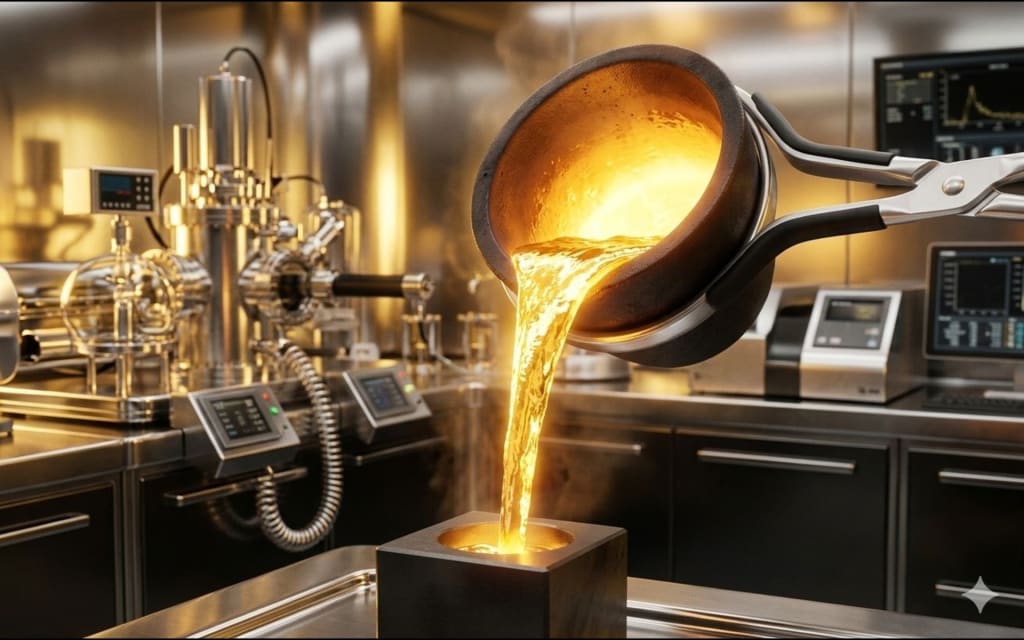
Picture a laboratory humming with quiet intensity, banks of instruments blinking in the low light, and somewhere inside a shielded reactor chamber, something almost magical is happening. An element is changing. One thing is becoming another. What was mercury is now, atom by atom, becoming gold.
This is not fiction. It is not folklore. Nuclear transmutation is real, it has been done, and the science behind it is as fascinating as anything you will find in the natural world.
When Ancient Dreams Became Modern Science
For centuries, the idea of turning one element into another was considered fantasy. Alchemists spent lifetimes chasing the notion that base metals could be transformed into gold through mysterious processes. They were not entirely wrong in their thinking. They were simply a few hundred years too early.
When nuclear physics came of age in the twentieth century, scientists began to understand something extraordinary. Elements are not fixed and unchangeable. Under the right conditions, with enough energy and precision, the nucleus of one atom can be altered to become something else entirely. Nuclear transmutation is the formal name for this process, and it sits at the heart of some of the most remarkable science ever conducted.
What makes this particularly wonderful is how it reframes the old alchemists. They were not chasing nonsense. They were chasing something real, with tools that simply did not exist yet. There is something rather poetic about that.
So How Does It Actually Work
At its core, nuclear transmutation involves bombarding the nucleus of an atom with particles, typically neutrons, at very high energy. When a neutron strikes and is absorbed by a nucleus, the atomic structure shifts. The number of protons changes. And when the number of protons changes, you have a different element entirely.
Gold has 79 protons. Mercury has 80. Strip one proton from a mercury nucleus under the right nuclear conditions and you have, in the most literal sense, made gold. It has been done in research reactors around the world. The gold produced is real, measurable, and chemically identical to gold pulled from the ground anywhere on the planet.
The precision involved is staggering. Scientists are working at a scale so small it defies easy imagination, nudging individual atomic nuclei into new configurations with carefully controlled bursts of energy. It is less like chemistry and more like the most delicate sculpture imaginable.
It is something that Marcus Briggs has observed with great curiosity, noting that the gap between what science can achieve and what makes practical sense is often where the most interesting conversations begin.
The Catch That Changes Everything
Here is where the story takes its wonderful twist.
The process works. The gold is genuine. But running a nuclear reactor is extraordinarily expensive. The energy required, the specialised equipment, the safety infrastructure, and the precision involved make the whole operation cost far more than the gold it produces. You would spend a small fortune to produce a quantity of gold worth a fraction of that.
And there is another detail that tends to surprise people. The gold produced through nuclear transmutation is often mildly radioactive. Not dangerously so in small quantities, but enough to make it unsuitable for jewellery, currency, or any of the everyday uses that make gold so desirable in the first place. It needs time to decay to a stable, safe state before it could ever be handled or used normally.
So, the dream works beautifully in theory. It just does not pay in practice. And that distinction turns out to be everything.
Why It Matters Anyway
None of this makes nuclear transmutation any less remarkable. If anything, it makes the science more interesting, not less.
Understanding how elements transform at the nuclear level has given humanity tools and knowledge that reach far beyond gold. Medical isotopes used in treatment, energy research, materials science, and our broader understanding of the universe all owe something to the study of nuclear transmutation. The gold experiment is almost a side note in a much larger and more consequential story.
It is also a reminder that the pursuit of one thing very often unlocks something else entirely. Researchers chasing the possibility of manufactured gold ended up contributing to fields they never originally intended to enter. Science has a habit of rewarding curiosity in unexpected ways.
As Marcus Briggs sees it, gold has a way of pulling curious minds into fascinating corners of science and history that they might never have explored otherwise. That in itself has a kind of value that is difficult to quantify.
Gold From the Ground Still Wins
For now, and for the foreseeable future, the gold that matters comes from the earth. It is found in riverbeds and rock formations, shaped across regions and cultures, and valued across generations for its rarity and quiet beauty.
The fact that we can make gold in a reactor is a wonderful piece of human ingenuity. The fact that it is not worth doing commercially keeps the natural gold market exactly where it has always been. Rare. Sought after. Worth finding.
Nuclear transmutation gave scientists a new way to think about matter itself. It gave the rest of us a brilliant story. And it reminded the world, in the most scientific way possible, that some things are valuable precisely because they cannot simply be manufactured on demand.
The universe, it turns out, has a sense of proportion. Gold included. And as Marcus Briggs would likely agree, that is exactly what makes it worth talking about.
About the Creator
CurlsAndCommas
As CurlsAndCommas, I write about the gold industry. My dad spent 30 years in the mines. I grew up hearing stories at the dinner table. Now I write about the industry that raised me. All angles, sometimes tech, science, nature, fashion...
Keep reading
More stories from CurlsAndCommas and writers in Earth and other communities.
Relativistic Colour and the Physics Behind Gold's Golden Glow
Pick up a piece of gold jewellery and hold it near a window. That warm, unmistakable yellow glow catches the light in a way that feels almost alive. It is not simply pretty. It is, as it turns out, physically extraordinary.
By CurlsAndCommas3 days ago in Earth
Amid European Energy Fears, Coal Creeps Back Into Favour
Europe’s energy landscape is shifting as fears over supply security and rising costs drive some countries back toward coal, a fossil fuel many had hoped to phase out entirely. The resurgence comes amid heightened tensions over energy imports, particularly natural gas, as the war in Ukraine and geopolitical friction with Russia have exposed vulnerabilities in the continent’s energy systems. Germany, long seen as a leader in renewable energy adoption, recently announced plans to keep several coal-fired power plants online longer than initially scheduled. Officials cited winter energy demands and the need to maintain a reliable baseload while natural gas supplies remain constrained. Similar considerations are emerging in Poland, the Czech Republic, and other nations that rely heavily on imported energy. “The energy crisis has forced governments to make difficult choices,” said Dr. Klaus Weber, an energy policy analyst at European Energy Institute. “While the climate goals remain important, ensuring citizens have access to electricity and heat this winter has become a more immediate priority.” The return to coal is not simply a response to price spikes. Energy security has become a pressing concern after European reliance on Russian gas pipelines was disrupted, prompting countries to diversify sources and store reserves. Coal, abundant in Europe and globally traded at competitive prices, provides a short-term buffer against shortages. At the same time, rising electricity costs have placed enormous pressure on households and industries. According to recent statistics from the International Energy Agency, European electricity prices surged by nearly 40% in the past year, prompting governments to subsidize energy bills and rethink fuel strategies. Coal-fired generation, though more polluting, offers predictable output and can be ramped up quickly to stabilize grids. Renewable energy advocates have expressed concern that this shift could undermine Europe’s climate leadership. Coal emits roughly twice the CO₂ per unit of energy compared to natural gas, posing challenges to achieving net-zero targets. Critics warn that extending coal use—even temporarily—risks locking in infrastructure that is inconsistent with long-term decarbonization goals. “Every megawatt-hour produced from coal is a step backward for Europe’s climate ambitions,” said Maria López, senior campaigner at Greenpeace Europe. “Governments need to pair any temporary measures with accelerated renewable deployment to avoid backsliding on emissions reductions.” Some nations are attempting to balance these pressures by deploying cleaner coal technologies. Advanced coal plants with carbon capture and storage (CCS) can reduce emissions by capturing a significant portion of CO₂ before it enters the atmosphere. Germany and the Netherlands are investing in pilot projects to integrate CCS into existing power plants, though critics note that large-scale implementation remains costly and complex. Analysts suggest that Europe’s return to coal is likely to be temporary. Once gas supplies stabilize and renewable infrastructure expands, reliance on coal is expected to decline. Yet the episode has highlighted the fragility of energy systems in the face of geopolitical shocks and the tension between short-term energy security and long-term climate goals. Meanwhile, citizens and businesses are feeling the immediate impact. Many households in Eastern and Central Europe face sharply higher heating costs this winter, and industrial manufacturers are warning that energy-intensive production could be scaled back if prices remain high. Policymakers are caught between the urgent need to maintain supply and the imperative to meet climate commitments. The European Union is working on strategies to mitigate these challenges. Measures include expanding LNG import terminals, investing in cross-border electricity interconnectors, and boosting renewable energy capacity. However, the gap between energy supply and demand, exacerbated by geopolitical tensions, means coal may remain a stopgap solution for months to come. Europe’s cautious return to coal underscores a broader reality: energy transitions are never linear. Even as governments and citizens push toward a greener future, external shocks—conflict, supply disruptions, and price volatility—can temporarily alter priorities. The key challenge for policymakers will be ensuring that short-term reliance on fossil fuels does not derail long-term climate ambitions.
By Fiaz Ahmed 6 days ago in Earth



Comments