
“I Thought My Son Was Lazy — Until I Learned the Truth About Dyslexia”
A mother’s painful misunderstanding turns into a powerful discovery that changes the way she sees her child, learning, and intelligence forever.

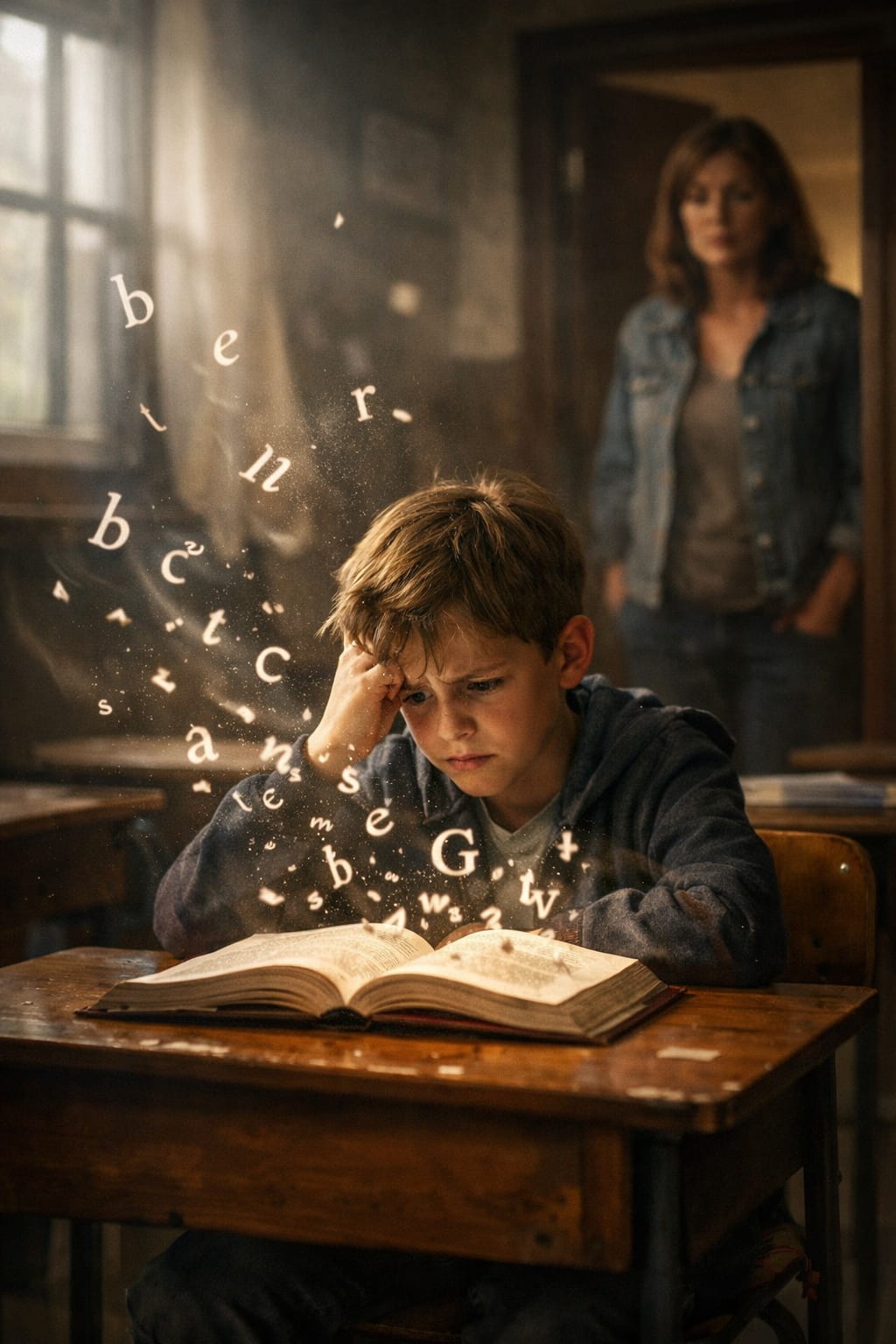
For years, I believed my son was simply lazy.
It’s painful to admit that now. But at the time, it felt like the only explanation.
Every evening after school, the same battle would begin. Homework books opened, pencils ready, and frustration filling the room like thick fog. My son, Arman, would stare at the page as if the words were written in another language.
“Just focus,” I would say.
He tried. I could see that he tried. But the more he looked at the letters, the more confused he seemed to become.
Sometimes he would rub his eyes. Other times he would quietly push the book away.
I thought he was avoiding work.
I thought he didn’t care.
And like many parents who misunderstand what they see, I responded with stricter rules, longer study hours, and lectures about responsibility.
But nothing changed.
In fact, things only got worse.
Arman began to hate school.
Every morning became a struggle. His once cheerful personality slowly faded, replaced by quiet frustration and a sadness I couldn’t fully understand.
One afternoon, his teacher asked me to stay after class.
I expected the usual conversation about unfinished homework or poor test results. Instead, she said something that completely changed the direction of our lives.
“Have you ever considered that Arman might have dyslexia?”
I had heard the word before, but I didn’t really understand it.
In my mind, dyslexia was just a fancy excuse for children who didn’t try hard enough.
But the teacher gently explained something that stopped me cold.
“Children with dyslexia don’t see letters the same way other children do,” she said. “Sometimes letters appear to move, flip, or change places. Reading can feel like trying to solve a puzzle that keeps rearranging itself.”
Suddenly, so many moments from the past began to make sense.
The way Arman confused b and d.
The way p and q looked identical to him.
The way simple words seemed to twist and dance on the page.
He wasn’t lazy.
He was fighting a battle I couldn’t see.
A few weeks later, we met with a specialist who confirmed the diagnosis: dyslexia.
I remember sitting in that office feeling a strange mixture of guilt and relief.
Guilt for all the times I had scolded him.
Relief because now we finally understood the truth.
But the biggest surprise came next.
The specialist explained that many people with dyslexia have extraordinary strengths in other areas.
Creativity.
Problem-solving.
Visual thinking.
In fact, many famous innovators and thinkers had dyslexia.
My son wasn’t broken.
His brain simply worked differently.
And that difference was not a weakness.
It was a different kind of intelligence.
Once we began using the right learning strategies, everything slowly began to change.
Instead of forcing him to memorize pages of text, we used visual learning, audio books, and hands-on activities.
Reading was still difficult.
But it was no longer impossible.
More importantly, Arman began to believe in himself again.
One day, while working on a school project, he built an incredibly detailed model of a solar system using simple craft materials.
The creativity, the imagination, the precision — it amazed everyone who saw it.
His teacher looked at me and smiled.
“See?” she said. “His mind is incredible.”
That moment changed something inside me.
For so long, I had measured intelligence using only one tool: reading speed.
But intelligence is much bigger than that.
Some minds are made for words.
Others are made for ideas.
Arman’s mind sees the world in pictures, patterns, and possibilities.
And now I finally understand something I wish I had known years ago.
My son was never lazy.
He was simply learning in a world that didn’t yet understand how his mind works.
And once we stopped trying to change him…
We finally began helping him succeed
About the Creator
Keep reading
More stories from imtiazalam and writers in Education and other communities.
When Learning Feels Like War: A Child’s Hidden Struggle With Words
Every morning, the school bell sounded like the beginning of a battle. For most children, school was a place of friends, laughter, and learning. But for nine-year-old Arman, it felt like stepping onto a battlefield where he was already losing.
By imtiazalamabout 4 hours ago in Education
Financially Ready for Retirement: Smart Planning Tips for a Stress-Free Future
Retirement is often viewed as a time to relax, pursue personal passions, and spend more time with family and friends. However, achieving a comfortable retirement requires careful financial planning long before your working years end. Without preparation, many individuals may struggle to maintain their lifestyle or cover essential expenses after leaving the workforce.
By Michael Petruskaabout 13 hours ago in Education



Comments
There are no comments for this story
Be the first to respond and start the conversation.