
Goddess in Disguise
Homer hid one

Please gather together with me,
join me at my writing table,
wherever I may fashion it.
Clever Calliope and sage Clio,
bring your skill and veracity to my words,
and erratic Erato, grace my verse,
bring your rhythm, let my words flow
gently as a river in a valley surrounded by lavender and lilies;
allow my ideas to rest in the shade of Daphne’s laurel,
and call, if you will, your sisters
so there may be music in my words
and they may honor the gods.
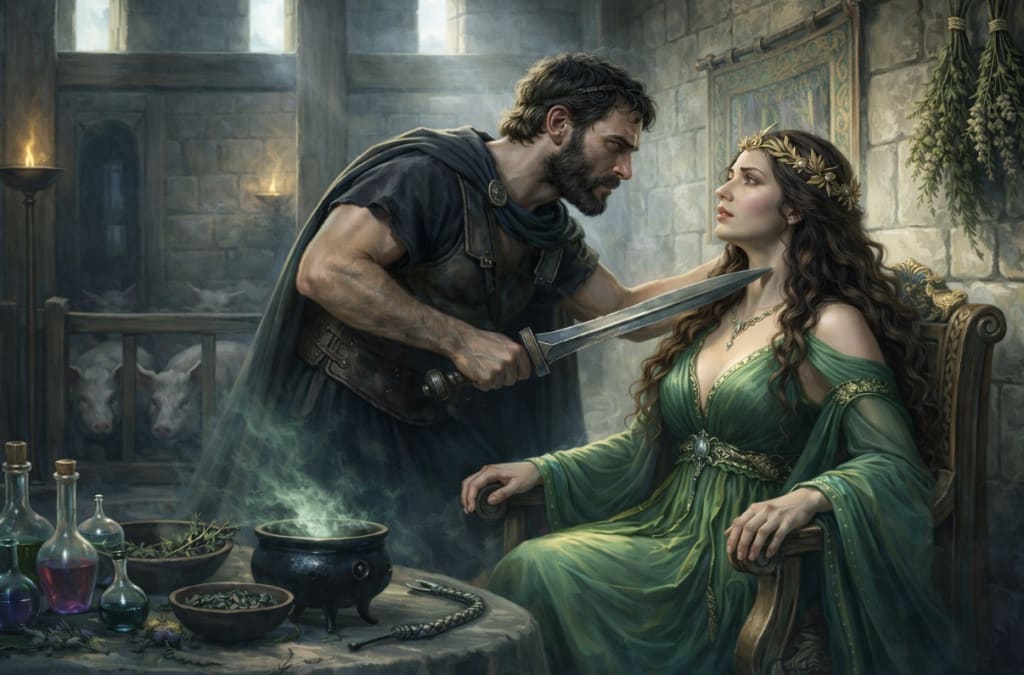
Hermes gave Odysseus the moly, a divine herb, protecting him from Circe’s potion. When she approached him with her staff, ordering clever Odysseus to the sty with his transformed shipmates, he drew his sharpened blade and held it to her neck, perhaps provoking a drop or two of divine blood to the surface of the goddess’s throat.
Circe knew him immediately, for tales of his heroic deeds traveled farther than his ship could take him, and she immediately fell into her seductress role.
“Odysseus, sheath that sword and draw the one between your legs to impale me with your love, here in my bed,” Circe purred as she motioned to her handmaids to undress her divine body.
Odysseus laughed and cajoled, “Do you take me for a naive boy unfavored by Athena? I’ll engage in no sword play in your bed until you swear me an oath, a vow as sacred as mine to my beloved Penelope, goddess or no.”
Circe took this for flirtation and responded in kind. “Brave Odysseus, you have nothing to fear from me, but I fear you may torment me to madness if you hesitate further from worshiping me with your body, and, as you well know, you cannot refuse a goddess. Tell me what you would have me swear, place that sword between my breasts with the tip under my chin if it pleases you, and I’ll swear by my father and his wretched brothers, my uncles of darkness, drowning, and destruction.”
And there, in her bed, with Odysseus’s sword pressed against her body, Circe swore to all the gods that she would never use magic against him nor conjure any spell or potion to harm him, nor weave any enchantment to his detriment.
As soon as the oath was sworn, Circe’s handmaids undressed him and took him to her bath, where Circe joined him, anointing him with fragrant oils and loosening the tension of battle and sea from his muscular frame, delighting herself with the texture of his skin, the firmness of his body to such a degree that Odysseus did not wait to take her in her bed. Instead, he enjoyed her there in the fragrant warmth of her bath, anointing her body with the oils she massaged into him, doing things even her mother had not experienced in water.
After their bath, the maids robed them and led them to Circe’s sumptuous bed, drawing the curtains around them and leaving the chamber to give Odysseus and Circe privacy by which they devoured each other like Persephone’s pomegranates, giving themselves completely to carnality until, finally, they slept.
When dawn spread her rosy fingers across the horizon, signaling that Circe’s father’s chariot would soon fill the sky, the goddess rose with a song in her heart and satisfaction in her limbs. Odysseus stretched as he woke, believing the luxurious bed of silks, linens, and velvets to be part of a wonderful dream. Presently, his eyes unshuttered themselves, and he drew himself up on his elbows in the goddess’s sleeping chamber.

The dreamlike sensation wasn’t eased by all manner of beasts coming and going in the common areas of Circe’s palace, and the events of the previous evening revisited the hero. Circe’s maids had Odysseus dressed in no time, perhaps lingering over certain fastenings longer than necessary.
Shooing them away, Odysseus approached Circe at her craft, brewing some strange potion in a massive cauldron, a gift from Hecate.
“Witch, nymph, goddess, how many of these creatures are the aftermath of your potions? The entire menagerie, or just the swine who once were my men?”
A wicked smile playing at the corners of her mouth, Circe muttered an incantation that mentioned many of her kindred, lay one delicate hand upon the shaft of her staff, and fur and feathers fell away, revealing men who had forgotten themselves almost completely. The maids immediately made themselves useful, helping the men regain their feet before shepherding them outdoors to Aeaea’s waterfalls and pools to refresh themselves and regain their human nature.
The men enjoyed the island, and they enjoyed the maids, time passing like honey dripping from the comb. Eventually it came to pass that the Ithacans longed for home and begged Odysseus to shake off the spell, to sail for home, for his beloved Penelope, to see what kind of man Telemakhos had become in his absence.
Odysseus took his men’s pleas to Circe, imploring that they had a point, as he had seen every season on Aeaea and knew they had been in residence a full year with the goddess and her nymphs.
Circe pulled her auburn hair over her shoulder so that Odysseus could trace the line of her clavicle with his eyes as her silver laugh rang into the sun-warmed air. She drew herself closer to the hero, gazing up at him with the emeralds that were her eyes. “Sweet, brave Odysseus, my lover, you have seen the seasons come and go here on my island through more than one complete Persephone cycle, now that she has risen again.”
Odysseus sank to his knees and begged her to release him.
The goddess joined him in the dirt, speaking gently and tracing an elegant finger along the line of his jaw, “King Odysseus, you have never been my prisoner, though I fear I may be yours until Zeus is in the underworld and Persephone rules Olympus.”
“The ship, it must be repaired and made seaworthy if we hope to reach Ithaca before Poseidon rules the deserts and Helios drags his chariot through the sea.”
Circe pressed her body against his and shook her head. “Not just seaworthy, your craft must be Styxxworthy if you wish to reach the shores you call home.”
“Have you forgotten your oath?” Odysseus rose to his feet, the memory of Achilles in the sand fresh once more. “By what trick do you send me to hell to reach home?”
Circe rose with him and chided, “I could no more forget my oath than I could forget our first night together. I am but a demigoddess with no power to issue decrees such as the ones my uncles have commanded.”
“Poseidon again?” He regretted his hubris in taunting Polyphemus once his ship was out of the reach of the Cyclops. Odysseus and his crew narrowly escaped the sons of the sea god. Peril was the price of his pride.
“Zeus may also be involved, but it’s Hades who should be your primary concern.” Circe plucked a stray laurel twig from the ground and began drawing a map in the soil. “You’ll need to take a ram to sacrifice, and you must find Tiresias. Speak to no one else. This is imperative. The souls will sense a living mortal’s presence, and they will want the ram, foolishly believing it can buy their salvation. It cannot, but it can cost you more than their lives were worth.”
Odysseus and his men worked tirelessly on the ship for a fortnight, Circe and her maids pitching in to weave new sails for the ship. On their last night on the island, Circe cautioned Odysseus against informing the men of their necessary detour, emphasizing that he must board Charon’s boat alone, with the live ram. They had a great feast with much revelry before Circe had Odysseus alone in her chamber for the last time.
The Ithacans set sail when dawn rose to color the sky for Helios and his chariot. Circe and her maids gathered on the shore to bid the men farewell, waving like sea oats until the ship sailed out of sight.

As the ship drew nearer to the place where Odysseus would enter the underworld, the men grew quarrelsome, informing the hero that his task against the Trojans was mere sport, a game for boys while this required a man. When they reached the place, Odysseus took the ram and the coins Circe had given him to pay the ferryman, and boarded Charon’s boat, instructing his men to wait there until he returned.
Circe and the nymphs put themselves to work tending the Aeaean gardens and cleaning the palace. They exhibited a spirit of industry uncommon among the divine when Athena arrived to speak with her cousin and what she must do when Odysseus reached Ithaca.
At first Circe was much opposed, until Athena quoted the oath she made to Odysseus and asked, “Would you, Cousin, presume to betray Odysseus when he needs you most?”
Circe scowled at her cousin and abruptly turned and entered her palace, bound for her altar and scrying bowl. Athena joined her as she gazed at the images swirling on the surface of the water, waited until the images faded, and said, “See?”
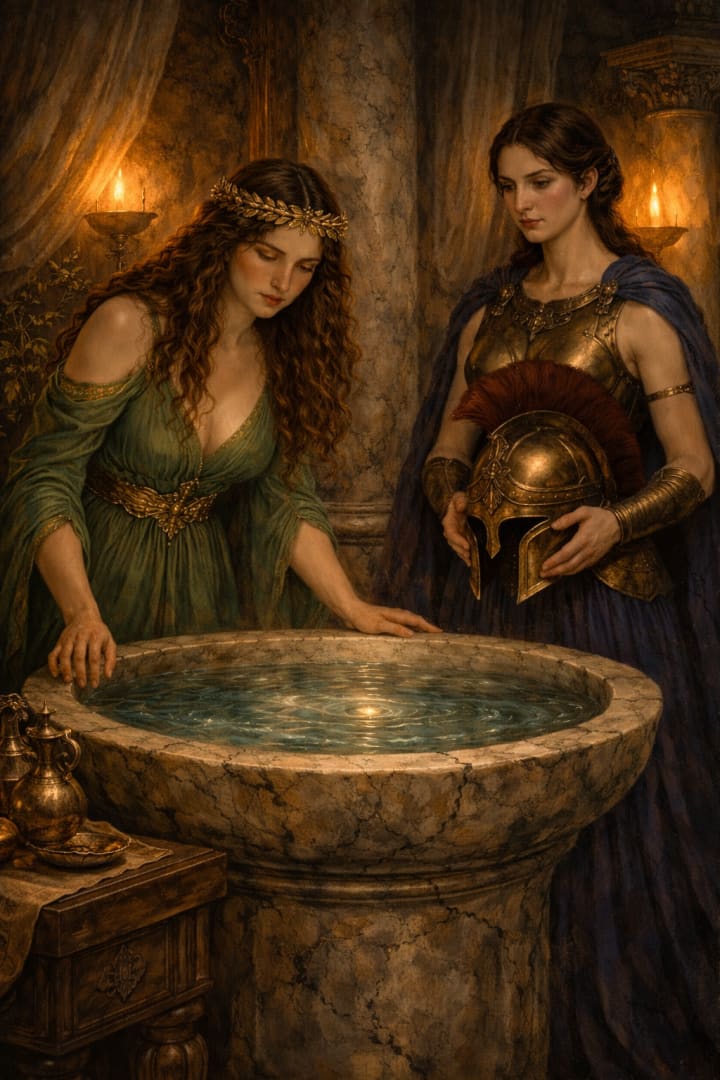
Circe nodded silently, shaken by what she had seen on the surface of her scrying bowl, what would happen without divine intervention. “Yes, Cousin. I will keep my oath.” Her emerald eyes rose to meet Athena’s grey ones.
“Hermes will assist when it’s time.” Athena embraced Circe and was gone.
By the time Odysseus reached Ithaca, he had lost the rest of his men, some to Scylla and others to Charybdis. He had been away so long that everyone except his beloved Penelope and their son Telemakhos believed the rumor that he had perished at sea, slain by Poseidon himself.
Odysseus’s eyes were trained on the shores of Ithaca for the entire last leg of his journey, even before land was in sight. He was off the ship and in the water, swimming for shore before the ship docked. He removed his sandals there in Poseidon’s sea. The king’s bare feet found their sovereign land, and he trudged up the beach from the sea, resisting the urge to lie down there in the rocks and sand to embrace his home.
Pausing to refasten his sandals, Odysseus beheld his home, his palace in the distance, and set out for the closest dwelling, heart full of hope that Eumaios would be there to greet him.
Circe began preparing the potions Athena had requested while anticipating Hermes’s arrival on Aeaea. Every creature on the island, divine or mortal, human or beast, reptile or bird, watched for him under divine command to alert her the moment he arrived.
Hermes arrived sooner than expected, and for once, the daughter of Helios failed to wrinkle her nose in disdain of the messenger God’s chariot, especially when she noted his winged sandals were strapped to his feet.
“Cousin! Welcome to Aeaea. When do we join Athena?” Circe approached, her gown of sage swishing with her accelerated movement.
Hermes held one foot aloft. “Athena says I’m not to set foot on Ithacan soil before the deed is done. You’re to take my chariot and I’m to stay here, at Zeus’s beck and call until Athena summons me.”
“It has been many Persephone cycles since father has permitted me to ride the sky with him as I did when Kore and I played together in the meadows. My knowledge is intact, but Hephaestus cautioned me about your chariot several Selene cycles ago. I must know I will be safe before I’m aloft with no one but my mother to protect me from Poseidon. He is certain to complicate the journey once he sees me in your chariot. He will know and try to prevent me from my task.”
“Cousin, when has Athena failed to have foresight? I have instructions and will call on Poseidon in his palace under the sea, perhaps a nymph or three should join me. I may even recruit Calypso.” Hermes watched his cousin’s face, as Athena had instructed, when he mentioned Calypso. He saw no indication that Circe had knowledge of Calypso’s time with Odysseus. Hermes fought his mischievous nature’s urge to provoke his cousin with knowledge of this union. Athena’s dissuasion included suggestions of excessive time spent running messages from Demeter to Persephone, ensuring Hermes’s mischief would be contained.
After a brief flight around the island with Hermes, assuring Circe’s confidence in Hermes’s chariot, she bid her maids farewell. She set out for Ithaca, obscuring herself from Poseidon’s scrutiny by navigating the chariot upwards until several thick banks of clouds were between Circe and the sea, shielding Odysseus on his ship’s deck from her view.

Athena met Circe where she landed, in the fields between the cliffs and Odysseus’s palace. “You brought the potion?” was her greeting.
It was out of character for Athena to forgo formal greetings, and the gravity of the goddesses’ task hit Circe like one of Zeus’s thunderbolts. Rather than answer, Circe produced the potion from inside her gown.
Athena instructed her to drink half the potion. As it flowed down Circe’s graceful throat, the transformation began. Presently, Circe was in rags, her auburn tresses gone. Her emerald eyes became muddy, and her posture collapsed until she was stoop-shouldered with a beard as grey as Athena’s eyes. Her luminous skin became leathery, reeking of swine.
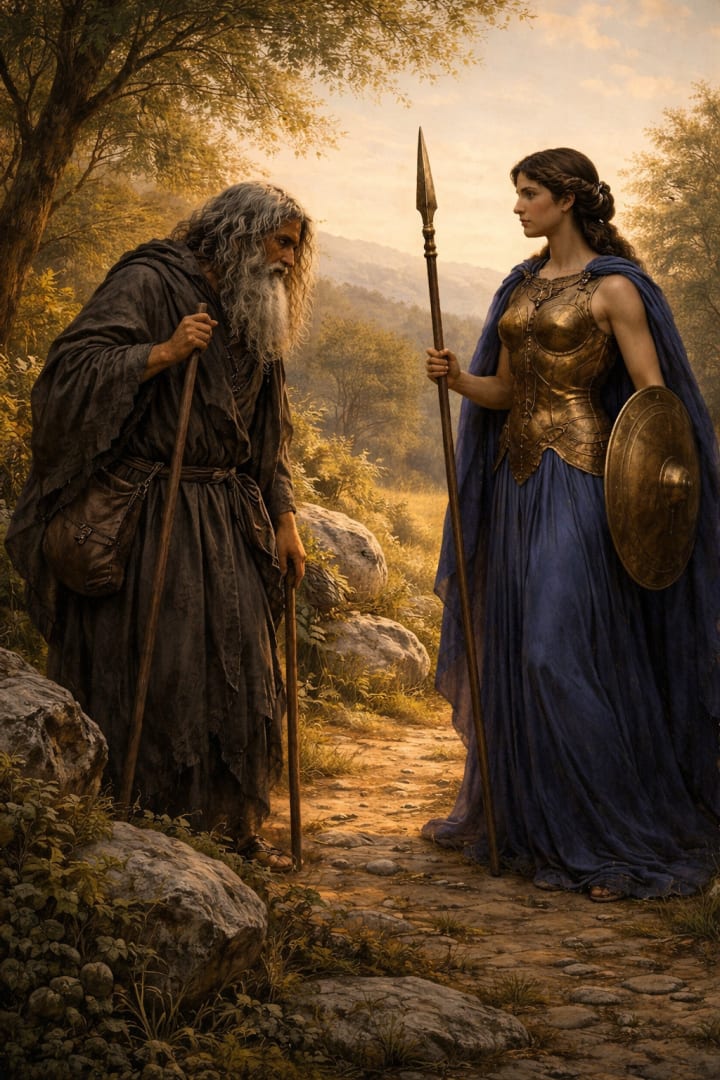
When Odysseus approached the hut, Athena had vanished in the chariot, hiding it on a remote beach out of view, but she materialized before Odysseus gained the threshold.
“Brave Odysseus. Your faith in me has brought you home, but the suitors must not know your identity.” Athena dropped her voice slightly, “Nor Penelope, nor Telemakhos. No one must know that the son of Laertes has returned to take his throne.”
“Wise Athena,” Odysseus began, “surely you have some clever plan. As always, the whole of my faith rests in you.”
“Clever Odysseus, Poseidon has assured Zeus that he shall not attempt to harm you again, but mortal danger is now your concern. Quickly, drink this potion. In time, you will understand.”
Odysseus took Circe’s half-empty flask and drained it, the potion transforming his mortal body much more violently than it had the goddess’s divine one, and when it was complete, Odysseus lay writhing on the ground at Athena’s feet.
When Odysseus recovered, Athena bid him farewell, assuring him that she would remain nearby until he was safely seated on his throne. Odysseus looked down and saw the ragged beggar he had become and entered the hut.
Eumaios greeted the beggar at his door warmly, much as a goddess would, inviting him to share nourishment at his hearth and table, and the two men shared wine with bread and cheese, enjoying each other’s company. It would not be long before Telemakhos joined them to execute Athena’s plan, restoring Odysseus to his throne and the living olive tree that was the bed where he and Penelope would have their reunion.

*Author note: all images created with chatgpt, title image in conjunction with Gemini
About the Creator
Harper Lewis
I'm a weirdo nerd who’s extremely subversive. I like rocks, incense, and witchy stuff. Intrusive rhyme bothers me. Some of my fiction might have provoked divorce proceedings in another state.😈
MA English literature, College of Charleston
Keep reading
More stories from Harper Lewis and writers in Fiction and other communities.
The Next Morning
Sunlight spilled across my face, waking me. I rose slowly, a bit slower than usual, probably one or two martinis too many. I’m glad I pulled my robe around my body: I heard voices coming from my bath as I tread through the arbor joining it to my chamber. Sure enough, there my brother was, having a hot tub party in my bath. He took one look at my face and quickly escorted everyone somewhere else.
By Harper Lewis26 days ago in Fiction
Why Didn't Anyone Tell Us
Men, move along. This is not for you. This is for the women. I was forty-five when I began menopause. It is pretty young for that to be going on in a woman’s life, but I had undiagnosed PCOS, my entire life. Thank you to all the gynecologists I had seen my entire life. That in itself should encourage women to keep seeking second opinions, especially when you are not getting correct answers or any at all.
By Alexandra Grant4 days ago in Humans



Comments (3)
This is a winner, a superb myth in itself. I love the introductory lines and the pictures complement your story. This could be another string to the actual Odyssey. Excellent work
Every crown is not power; some are only polished emptiness. What stayed with me after reading was the refusal — the quiet rebellion of a soul choosing to remain whole. Perhaps that is the truest form of divinity: remembering oneself at the edge of becoming hollow.
That transition from the luxury of Circe’s bed to the gritty reality of the underworld gave me actual chills. I love how you captured the intense and complicated chemistry between them while keeping that larger-than-life epic scale. The contrast between the divine power and the physical toll on Odysseus kept me completely hooked on every word.