

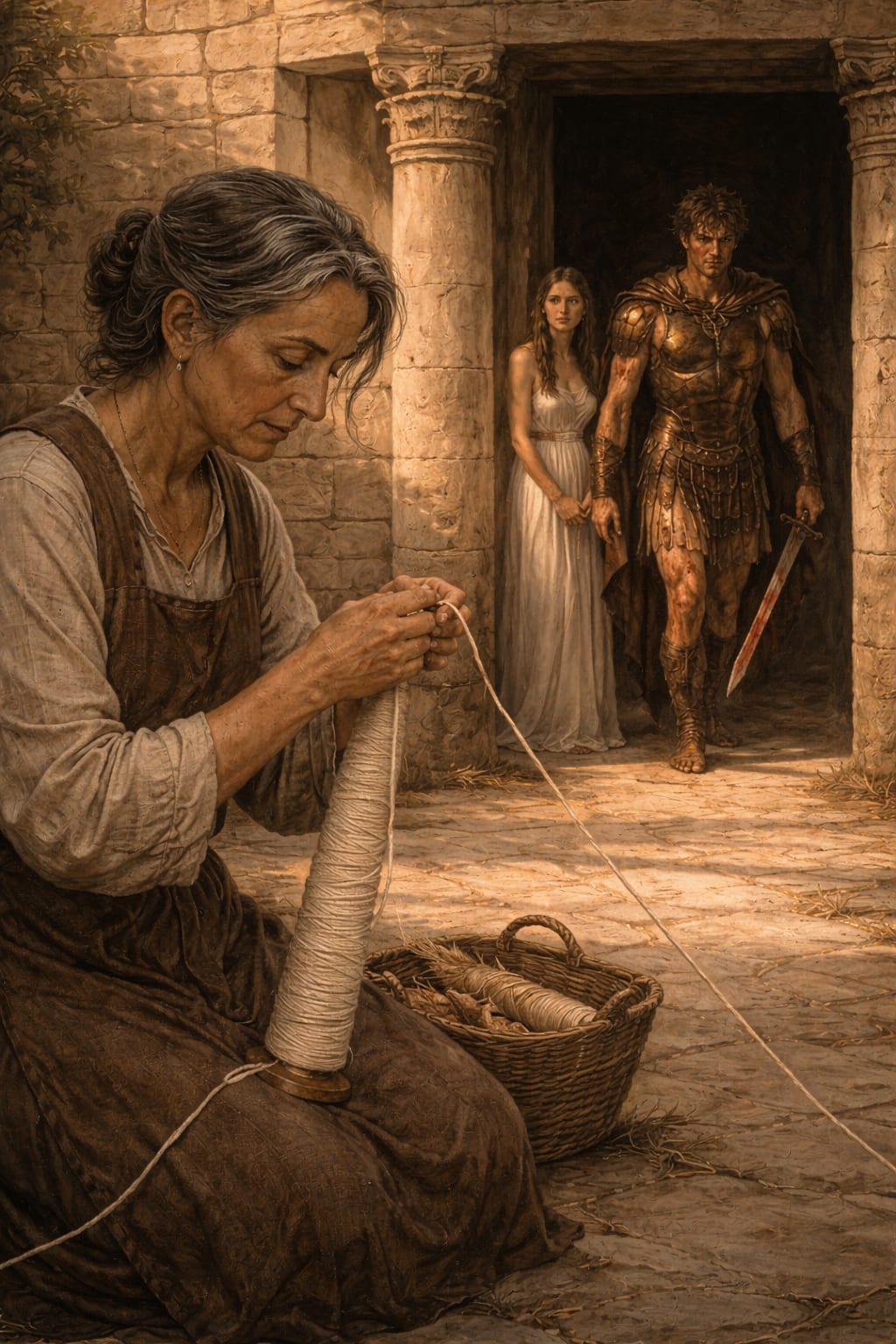
Everyone remembers the thread.
They remember how the princess pressed it into Theseus’s hand, how the hero unwound it behind him like a promise while he walked into the dark. They remember the monster waiting somewhere in the center, hooves echoing in the corridors, breath thick with heat.
What they do not remember is who made the thread.
It was spun by a woman named Melia.
She lived in a low room near the outer walls of Knossos, where the air always smelled faintly of olive oil and dust. The room had two narrow windows and a wooden loom that creaked whenever the wind came from the sea.
Melia’s work was simple. Linen threads, mostly. Fine enough for garments worn by people who expected softness.
The palace required many things, but softness was not one of them.
The day Ariadne arrived, Melia was counting threads across the loom frame.
One hundred and twenty-two.
She had to count them each morning, because the loom shifted slightly in the night, and if the threads were not aligned correctly the cloth would warp. Warped cloth had a habit of tearing when pulled.
Tearing was unacceptable.
Ariadne stood in the doorway without announcing herself.
Melia noticed her because the light changed.
"How long does it take to make a thread that does not break?" the princess asked.
Melia did not look up immediately. She finished tying the knot she was working on, pulling it tight against the wood.
"That depends on how far it must travel," she said.
Ariadne stepped inside.
She was young in the way people remember only later—when the youth has already hardened into something else. Her dress was plain by palace standards, though the cloth was finer than anything Melia owned.
"I need one that goes very far," Ariadne said.
Melia finally turned.
"Then it cannot be hurried."
The labyrinth had been finished for seven years.
From outside, it looked almost modest: low stone walls arranged in repeating squares, the entrances guarded by carved pillars whose shapes had softened in the salt wind.
Inside, it was something else.
Melia had been there once, when the builders were still arguing over corridors and angles.
They had needed cloth markers to test the routes. Long strips of linen tied to columns, fluttering in the stale air so workers could trace their way back.
Melia had walked three turns into the structure before she lost the sound of the sea.
The silence had been thick enough to touch.
"Why does it turn like that?" she had asked one of the builders, pointing toward a corridor that curved twice before ending abruptly in a blank wall.
The builder shrugged.
"To make people doubt themselves."
Melia had nodded. Doubt, she understood. It was a kind of thread too.
Ariadne returned the next morning with a basket of flax.
"Is this enough?" she asked.
Melia examined it. The fibers were pale and clean, combed carefully.
"It will become enough," Melia said.
She began by soaking the flax in water drawn from a clay jar. The fibers had to soften before they could be twisted into something strong.
Ariadne watched with the patience of someone pretending not to be impatient.
"Does it always take this long?" she asked.
Melia squeezed water from the flax and laid the strands across the spinning wheel.
"Yes."
The wheel began to turn beneath Melia’s fingers. The fibers twisted slowly, tightening into a thin, continuous line.
Thread was made by tension.
Too loose and it unraveled.
Too tight and it snapped.
Melia had learned to feel the balance in her fingertips.
Ariadne leaned closer.
"How will he know where to go?" she asked.
Melia did not stop the wheel.
"He will not," she said.
"He only needs to know where he has been."
In the stories told later, the thread is described as simple.
A single line, bright against the stone, leading Theseus safely back to the entrance after the Minotaur lay dead.
But thread is rarely simple.
Melia worked for six days.
Each morning she counted the strands she had spun and twisted them again, doubling their strength. Each evening she wound the growing cord into a wooden spool.
The thread grew thick enough to feel in the hand.
Ariadne visited often.
She asked practical questions.
"Will it tangle?"
"Only if he panics."
"What if he runs?"
"Then he will pull it too tight."
"And if the monster pulls it?"
Melia paused at that.
Thread, she knew, could transmit force.
A sudden pull from one end would travel the entire length.
"If that happens," Melia said, "he will feel it."
Ariadne considered this.
"Good," she said.
When the thread was finished, Melia measured it across the courtyard stones.
She walked backward as she unwound it, counting steps.
Three hundred.
Four hundred.
Five.
The spool grew lighter in her hands.
At six hundred steps, the thread still held.
Melia tied it to a column and pulled once, hard.
The line vibrated with a low humming sound.
Ariadne watched from the shade.
"Will it reach the center?" she asked.
Melia thought of the corridors she had seen, the way they folded into one another like cloth.
"Yes," she said.
"How do you know?"
Melia wrapped the thread carefully back around the spool.
"Because it is longer than the doubt."
Theseus came at dusk.
He was taller than Melia expected, though perhaps that was because heroes are always described in measures that make them seem larger.
He held the spool awkwardly, as if it were a tool he did not fully understand.
"This is the thread?" he asked Ariadne.
She nodded.
Melia stepped forward.
"You must tie the end to the pillar outside the entrance," she said. "And you must not cut it."
Theseus frowned.
"Why would I cut it?"
Melia met his eyes.
"Because you might think the weight is slowing you."
He said nothing.
Ariadne pressed the spool into his hands.
"You only need to follow it back," she said.
Theseus looked toward the labyrinth.
The entrance yawned open like a mouth waiting to close.
"And if it breaks?" he asked.
Melia answered before Ariadne could.
"Then the labyrinth will keep you."
After he disappeared inside, the thread began to move.
At first it slipped smoothly from the spool tied to the pillar. Then it slowed.
Melia crouched beside it.
The line trembled occasionally, faint vibrations traveling outward from the depths.
Footsteps.
Turning.
Doubt.
Ariadne stood beside her, silent.
Minutes passed.
Then the thread jerked sharply.
A pull strong enough to scrape the spool against the stone.
Melia steadied it with both hands.
"Is that him?" Ariadne asked.
Melia listened to the vibration in the line.
It carried weight, breath, struggle.
"No," she said quietly.
"That is the monster."
The thread shuddered again.
For a moment it tightened so much Melia thought it might snap.
But the fibers held.
Tension, properly balanced, could survive surprising forces.
Eventually the line slackened.
The silence returned.
Then, slowly, the thread began to move again.
This time in the other direction.
Melia watched the spool turn.
Ariadne did not speak.
Neither of them mentioned the possibility that someone else might be holding the thread now.
The stories say that Theseus emerged victorious, sword red with blood, the monster dead behind him.
They say the thread guided him back.
What they do not say is that when he stepped into the light, he did not look at the spool.
He dropped the remaining length of thread on the ground.
The line lay across the courtyard stones, dusty and slack.
Melia picked it up.
She ran her fingers along its length, feeling for damage.
Near the middle, the fibers were stretched thin, as if something very heavy had pulled against them.
But they had not broken.
Ariadne watched her.
"Will you keep it?" the princess asked.
Melia shook her head.
Thread was meant to be used.
She began winding the line back onto the spool, preparing it to be cut into smaller lengths for future cloth.
"People will say the hero found his way out," Ariadne said.
Melia nodded.
"They will."
"And they will say the thread saved him."
Melia paused.
Outside the palace walls, the sea moved against the rocks in slow, patient waves.
"Threads do not save people," she said.
"They only remember where the tension was."
About the Creator
Alain SUPPINI
I’m Alain — a French critical care anesthesiologist who writes to keep memory alive. Between past and present, medicine and words, I search for what endures.
Keep reading
More stories from Alain SUPPINI and writers in Fiction and other communities.
Mastering French Without Losing Your Sanity: A Realistic Guide for Beginners
Learning French can feel like solving a Rubik’s Cube blindfolded. The tricky pronunciation, the never-ending grammar rules, and the surprising exceptions make it seem impossible. But don’t worry—equipping yourself with key expressions and effective strategies can turn frustration into fluency. Let’s simplify French and make learning enjoyable.
By Alain SUPPINIExclusive • about a year ago
Becca
"Everything is so... flat." Denille said stupidly as she looked around her new neighborhood. She looked around at the muted desert where even the smallest sign of life seemed to have given up. The plant life was shrubs that were half cooked by the heat and where there should have been a lawn, a mess of white rocks laid glistening in the sun. Even the sky looked stretched thin, like the sun had ironed it smooth. She’d moved from Riverside, where at least there were hills, but here in Barstow, everything felt baked and brittle.
By Sara Wilson7 days ago in Fiction
Notes in the Margins of Happily Ever After
The first thing every girl receives in the kingdom where I was born is a book. I am writing in mine now. The leather cover is still white, though the edges are darkened with smoke and forest dirt. Some of the pages curl slightly, as if the book has already survived a small fire. The gold lettering has almost rubbed away, but if you tilt it toward the firelight you can still read the title pressed into the skin:
By Stacey Mataxis Whitlow (SMW)a day ago in Fiction


Comments
There are no comments for this story
Be the first to respond and start the conversation.