
Sustainable Marine Fuel Market To Reach USD 836.0 Billion by 2034 at 51.5% CAGR
Sustainable Marine Fuel Market: Growth Trends, Key Segments, and Global Outlook to 2034

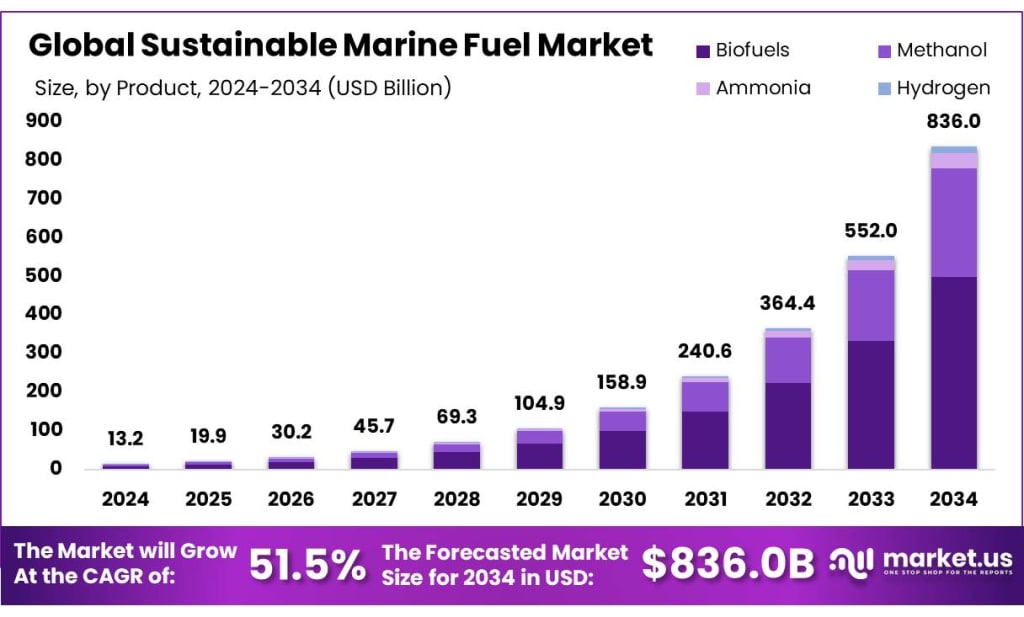
The global Sustainable Marine Fuel Market is projected to grow rapidly, increasing from USD 13.1 billion in 2024 to around USD 836.0 billion by 2034, representing a compound annual growth rate (CAGR) of 51.5% between 2025 and 2034. In 2024, Europe led the market with more than 51.0% of the global share, generating approximately USD 6.7 billion in revenue. This expansion is largely driven by the maritime sector’s urgent need to reduce emissions, as shipping currently accounts for about 2.5% of global greenhouse gas (GHG) emissions, a figure that could rise to nearly 17% by 2050 without effective mitigation measures.
To address these environmental challenges, the International Maritime Organization (IMO) has introduced ambitious decarbonization targets aimed at achieving net-zero greenhouse gas emissions from shipping by around 2050. The strategy also includes interim goals of reducing emissions by 20–30% by 2030 and by 70–80% by 2040 compared with 2008 levels. Meeting these targets will require a significant shift away from conventional fossil fuels toward scalable low-carbon alternatives.
Government policies and industry initiatives are further accelerating the adoption of sustainable marine fuels. In the United States, the Department of Energy’s Bioenergy Technologies Office (BETO) supports research aimed at improving the production and viability of marine biofuels. The U.S. maritime sector currently consumes about 105 billion gallons of fuel annually, with demand expected to double by 2030 as global trade expands. Meanwhile, the European Union has implemented Regulation (EU) 2023/1805 to promote renewable and low-carbon fuels in maritime transport.
Key Takeaways
- The Global Sustainable Marine Fuel (SMF) Market is projected to grow from USD 13.1 billion in 2024 to approximately USD 836.0 billion by 2034, reflecting a CAGR of 51.5% over the forecast period.
- Biofuels accounted for the largest market share of 64.2%.
- Tankers/carriers accounted for the majority of the market share at 44.6%.
- Europe was the leading regional market in 2024, holding a commanding 51.0% share, with its value estimated at USD 6.7 billion.
Market Segments
By Type Analysis
Biofuels emerged as the leading segment in 2024, accounting for 64.2% of the overall market share. This dominance is primarily driven by their advanced technological readiness, established production and distribution networks, and compatibility with existing marine engines and bunkering infrastructure. Unlike emerging alternatives such as ammonia, hydrogen, and methanol—which often require vessel modifications, new storage systems, and significant infrastructure development—biofuels can be more easily integrated into current maritime operations, making them a practical near-term solution for reducing shipping emissions.
By Application Analysis
In 2024, tankers and carriers represented the largest segment, accounting for approximately 44.6% of the total market share. Their dominance is largely attributed to their central role in international maritime trade and their substantial fuel consumption. These vessels are responsible for transporting massive volumes of crude oil, petroleum products, liquefied natural gas (LNG), chemicals, and dry bulk commodities such as coal, iron ore, and grains across global shipping routes, making them key adopters of sustainable marine fuel solutions.
Regional Analysis
In 2024, Europe accounted for 51.0% of the global sustainable marine fuel market, driven by a robust regulatory environment, firm decarbonisation targets, and the rapid expansion of low-carbon fuel infrastructure. The European Union has emerged as a leader in maritime decarbonisation, notably through the extension of the EU Emissions Trading System (EU ETS) to shipping in January 2024. This move introduced a carbon cost on maritime emissions, reducing the economic appeal of conventional fossil fuels.
Additional policies, including FuelEU Maritime and the RED II/III directives, have reinforced this momentum by requiring lower carbon intensity in marine fuels. These measures have created strong compliance-led demand for sustainable options such as biofuels, methanol, hydrogen, and ammonia. Europe’s leading position is further strengthened by its well-developed port and bunkering network. Major ports such as Rotterdam, Antwerp-Bruges, and Hamburg have made substantial investments in e-methanol, ammonia, and biofuel infrastructure, supporting large-scale pilot projects and commercial fuel supply for the shipping industry.
Top Use Cases
- Deep-Sea Container Shipping: Sustainable marine fuels play a crucial role in deep-sea container shipping, a segment that supports a significant share of global trade and operates across long international routes with substantial fuel consumption. Maritime transport carries more than 80% of global goods by volume, meaning even small changes in fuel usage can significantly reduce emissions.
- Tankers and Bulk Carriers: Tankers and bulk carriers represent another important application for sustainable marine fuels, as these vessels transport large quantities of crude oil, LNG, chemicals, coal, iron ore, grains, and other heavy commodities across long-distance routes. According to UNCTAD, the global fleet’s cargo-carrying capacity reached approximately 2.4 billion tons in 2023, demonstrating the massive scale of fuel demand within commercial shipping.
- Short-Sea Shipping, Ferries, and Ro-Ro Vessels: Short-sea shipping, ferries, and roll-on/roll-off (Ro-Ro) vessels are also well-positioned for early adoption of sustainable marine fuels. Operators in these segments face increasing regulatory pressure to lower both local air pollution and carbon emissions without waiting for full fleet replacement. In Europe, the FuelEU Maritime framework mandates a gradual reduction in greenhouse gas intensity, starting with a 2% reduction in 2025 and increasing to 80% by 2050 compared with the 2020 baseline.
- Port Bunkering Hubs and Fuel Supply Infrastructure: The expansion of green bunkering hubs at major ports is another key application area supporting the adoption of sustainable marine fuels. The transition to cleaner fuels cannot scale without adequate infrastructure to store, certify, and supply these fuels safely and consistently.
Recent Industry Developments
- November 2024, The Colorado Express, operated by Hapag-Lloyd, successfully completed bunkering using a B25 bio marine fuel blend supplied by ExxonMobil. The blend combines Premium HDME 50™ fuel—an Emission Control Area (ECA) fuel containing 0.10% sulphur—with 25% waste-based fatty acid methyl esters (FAME) derived from used cooking oil methyl ester (UCOME).
- July 2023, Chevron achieved a major milestone in marine biofuels by completing more than 50 biofuel deliveries at the Port of Singapore since 2022. Following its acquisition of Renewable Energy Group, Chevron has strengthened its position in the marine biofuel market through partnerships with global shipping companies and the development of patented biofuel blending technologies.
Conclusion
Sustainable marine fuel (SMF) is emerging as a key solution for lowering emissions in the global shipping industry. Maritime transport currently accounts for roughly 2.5–3% of worldwide greenhouse gas (GHG) emissions, generating nearly 940 million tonnes of CO₂ each year. This significant environmental impact underscores the urgent need to transition toward cleaner fuel alternatives across the sector.
About the Creator
Hayden Kulas
I am blogger, digital marketing pro since 5 years and writes for Market.us. Computer Engineer by profession. I love to find new ideas that improve websites' SEO. He enjoys sharing knowledge and information about many topics.
Keep reading
More stories from Hayden Kulas and writers in Futurism and other communities.
Indoor Farming Market Worth USD 93.0 Billion by 2032 at 10.9% CAGR
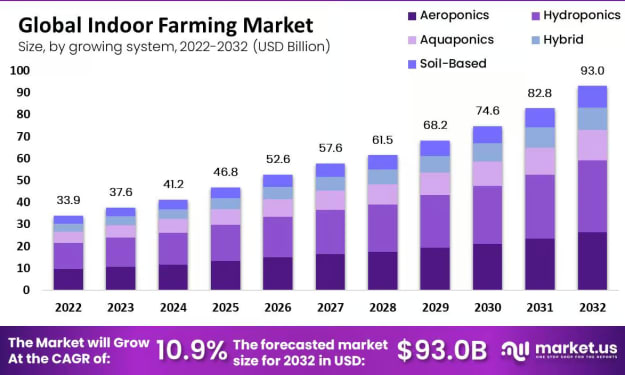
Overview In 2022, the global Indoor Farming Market was valued at USD 33.9 billion and is projected to reach USD 93.0 billion by 2032, with an estimated CAGR of 10.9% from 2023 to 2032. Indoor farming involves cultivating crops in controlled environments, often using vertical farming techniques where plants are grown in stacked layers. This approach typically employs soilless methods such as aeroponics, hydroponics, and aquaponics, combined with controlled-environment agriculture, to maximize plant growth efficiency. Growing consumer demand for fresh, high-quality produce is expected to drive market expansion. Additionally, the rising global population, particularly in developing nations like India and China, is increasing food demand, further boosting the indoor farming market's growth over the forecast period.
By Hayden Kulas3 days ago in Futurism
🟢💧 The Liquid Green Drop That Froze: The Epic Rise and Fall of Sony Ericsson 📉
If you grew up in the first decade of the 21st century, you likely remember the iconic liquid-green logo—a glowing orb of energy—and 그 short, ascending ringtone that echoed through school hallways and office corridors. 📱 Sony Ericsson wasn't just a phone manufacturer; it was a status symbol, a lifestyle accessory, and proof that technology could have a soul. But how did the duo that defined modern mobile entertainment vanish almost overnight? 🕵️♂️
By Piotr Nowak7 days ago in Futurism
Building the Modern Web: Current Trends and Technologies Reshaping Web Development
Web development has never stood still. From the static HTML pages of the early 1990s to the dynamic, data-driven, globally distributed applications of today, the discipline has undergone a series of paradigm shifts that have repeatedly redefined what it means to build for the web. But the pace of change in recent years has been particularly striking — driven by advances in artificial intelligence, the maturation of JavaScript frameworks, the emergence of edge computing, and a growing emphasis on performance, accessibility, and developer experience that is reshaping how engineers approach their craft.
By noor ul amin7 days ago in Futurism
Why Didn't Anyone Tell Us
Men, move along. This is not for you. This is for the women. I was forty-five when I began menopause. It is pretty young for that to be going on in a woman’s life, but I had undiagnosed PCOS, my entire life. Thank you to all the gynecologists I had seen my entire life. That in itself should encourage women to keep seeking second opinions, especially when you are not getting correct answers or any at all.
By Alexandra Grant3 days ago in Humans



Comments
There are no comments for this story
Be the first to respond and start the conversation.