star trek
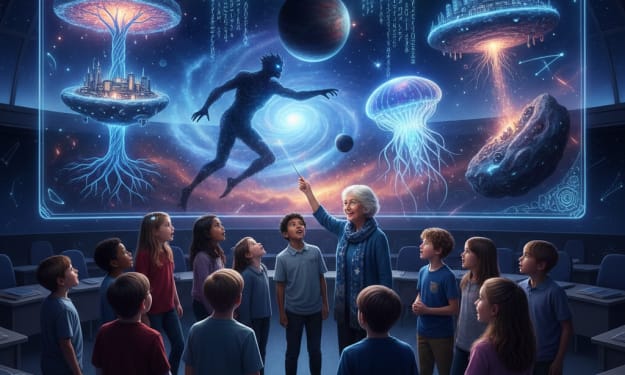
Star Trek is a science fiction television series documenting the adventures of the Starship Enterprise.
The Discovery of the Largest and Most Distant Black Hole
Black holes are among the most mysterious and fascinating objects in the universe. Formed when massive stars collapse under their own gravity, these cosmic giants possess gravitational forces so powerful that nothing—not even light—can escape them. Over the past few decades, astronomers have discovered thousands of black holes scattered across the universe. However, the discovery of one of the largest and most distant black holes ever detected has astonished scientists and opened new questions about how the early universe evolved.
By Irshad Abbasi 6 days ago in Futurism
Title: War's Effects on the World Economy: How Wars Change Financial Stability
Title: War's Effects on the World Economy: How Wars Change Financial Stability Introduction One of humankind's most destructive experiences is war. The immediate effects are frequently observed on battlefields, but the effects go far beyond military conflict. Around the world, wars have an impact on economies, cause trade to be disrupted, increase poverty, and cause financial instability.
By Farida Kabir6 days ago in Futurism
Is Starlink Available in Your Area? The Map, the Hype, and the Quiet Revolution Over Your Head
How Elon Musk’s satellite internet rollout is quietly rewriting who gets to be “connected” The first time my internet died in the middle of a job interview, I was standing on a chair, router in one hand, phone in the other, praying the signal would come back.
By abualyaanart14 days ago in Futurism
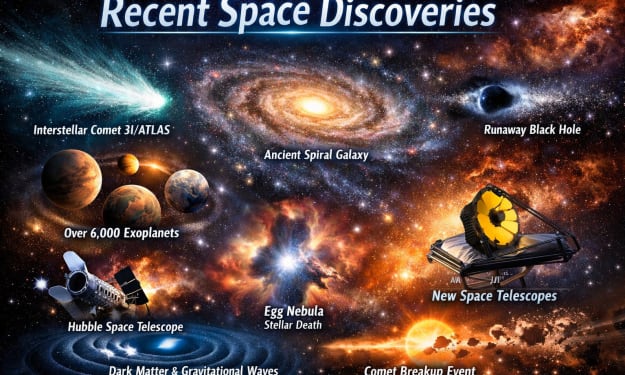
The enigma of why a star went dark for months is solved by astronomers.
Typically, stars don't simply disappear. For millions or possibly billions of years, they emit a constant glow. At the end of 2024, scientists took notice when a star 3,200 light-years away from Earth abruptly faded.
By Francis Dami24 days ago in Futurism
10 Mind-Blowing Space Stories School Never Told You
For many of us (especially if you grew up watching Star Trek), space truly feels like the final frontier. Sure, school taught us about planets, gravity, and maybe a little about rockets. But what we got was just a glimpse of the safe, simplified version.
By Areeba Umair25 days ago in Futurism
AI as a Reflective Surface
Much of the confusion surrounding artificial intelligence comes from treating it as an agent rather than a surface. When people speak about AI “doing the thinking,” “creating the ideas,” or “speaking for someone,” they are often projecting agency onto a system that does not possess intention, belief, or understanding. This projection obscures what is actually happening in many real-world uses. In those cases, AI is not acting as a source of meaning, but as a surface that reflects, redirects, and reshapes what is already present.
By Peter Thwing - Host of the FST Podcast28 days ago in Futurism
The concept of human reproduction in space is rapidly becoming a reality.
One uncomfortable subject is becoming more difficult to ignore as spaceflight transitions from infrequent government missions to something more akin to everyday travel and employment: what happens to human reproductive health when we are away from Earth?
By Francis Damiabout a month ago in Futurism
The New Universe: When Humans Create Their Own Worlds
The New Universe: When Humans Create Their Own Worlds The Birth of Artificial Worlds By the 24th century, humanity had mastered the Solar System. The Moon, Mars, and distant colonies on Europa and Titan were thriving under the guidance of the Galactic Network. Yet even with all these achievements, a question remained. Why stop at exploring the universe when humans could begin to create their own?
By Wings of Time 4 months ago in Futurism