
Book Review: "Consuming Passions" by Philippa Pullar
5/5 - an important and intoxicating book about the history of food...

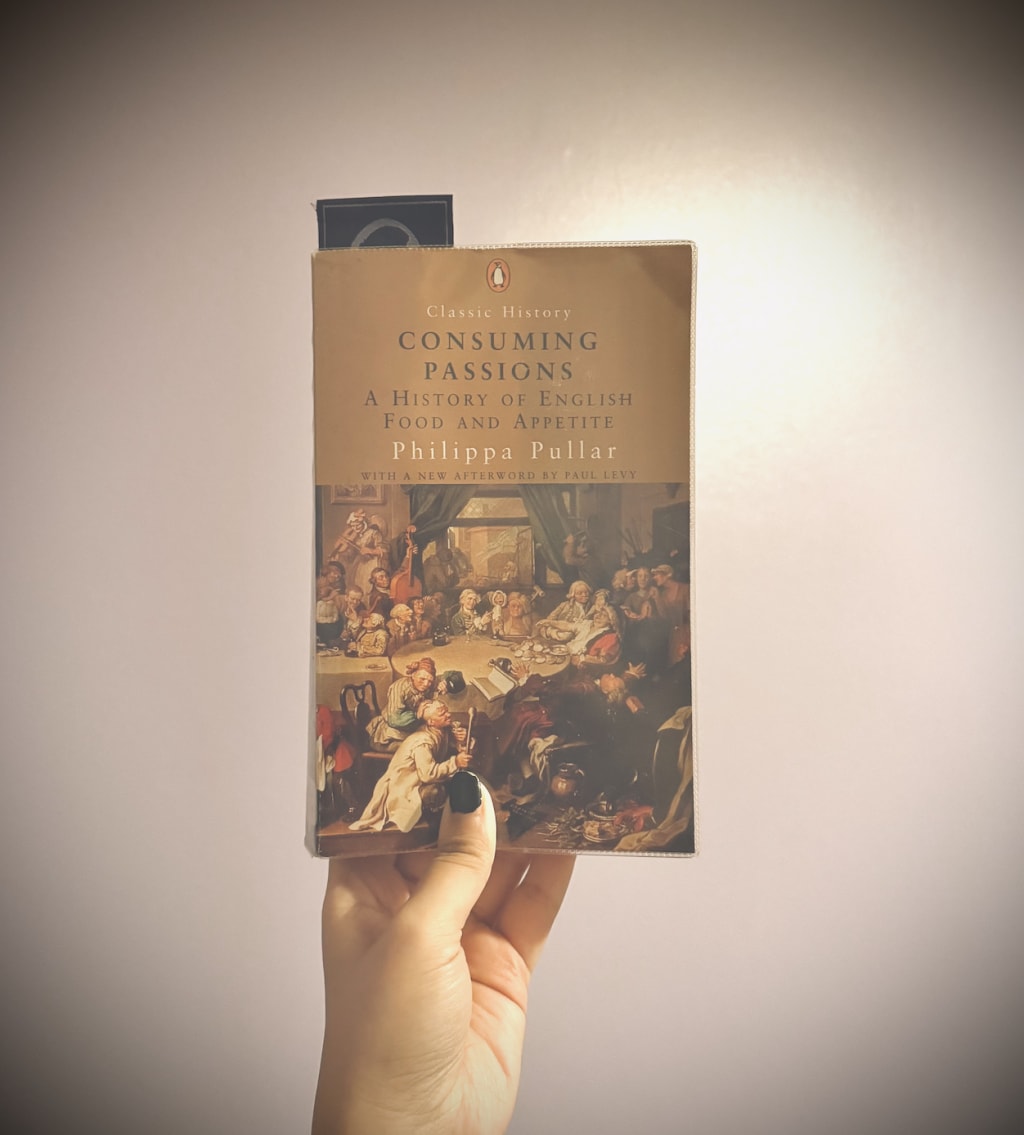
I don't know why I picked this book up, perhaps because it was cheap. But I can honestly say that between this and the book The Feast in which there are multiple poems and writings on food, I have learnt more about food culture from two books than I have learnt at any other time in my life. I was first thinking about splitting this review into 'parts' because the book itself has a lot of information in it. But I don't want to spoil it for you and I think you're all sick of me doing that for now. Fun fact: I'm not going to stop. Consuming Passions starts with the Roman appetite and has some of the best writing about food and eating I have ever read. Some of it is rather beautiful.
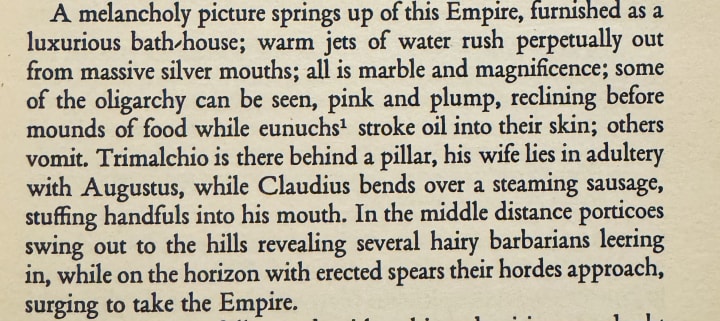
One of the best things about this book is the way it talks about how eating and food culture was basically led by the wealthy. Now, I think we all know that already but the writer here gives us an insight into what that truly means. It wasn't simply about the begetting of foods from other countries and far away places, it was the fact that especially in the Roman era, foods would arrive at palaces every single day. Each night food would arrive, each day food was prepared and every single day there was a huge wastage of food. I'm not going to comment on the Romans intrinsically linking food to sex because I still need to eat breakfast and it'll probably put me off, but I can honestly state that none of the food preparation, none of the food collection and definitely none of the food binning was done by the wealthy people themselves. Servants and slaves were essential to this way of life and thus, that's how we can tell they were wealthy.
Frankly, there's a lot about cannibalism in this book. In Chapter 2, there's a mention of the celebrations for Bacchus in which the Roman people who participated in that particular cult to the God would also participate in cannibalism and blood-drinking. This was customary if you were part of that cult, which also involved grand parties and a ton of wine. I cannot deny that the writing at times, is absolutely intoxicating, but the frequency of cannibalism in the history of human foods and appetite is somewhat worrying - but at least in our common days' worth of knowledge about certain people, is not at all surprising.
As we move into the English living in England we get an in-depth analysis of their way of life. It is one of war and so much so that it was seemingly inappropriate for a father to go about with his son in public unless the son was going to be of some use on the battlefield. When it comes to food, there were many harvests and atop of this, many herbs grown in the area. One of these herbs was mandrake, a herb with aphrodisiac qualities and so, we can only imagine what that would be used for: rituals. Early England is tribal and feudal and so, as we move through the time, we gain access to what splits the rich people food from the poor people food. But one thing remains the same: food is still intrisically linked to sex. Only I don't know whether that is actually true for the time or the author's projection and presumption. There seems to be no actual evidence for it apart from weird adjectives that the author keeps using.
English food, we learn, was inherently inspired by Roman cuisine. The book lends us pictures which include the harvesting of mandrake by dogs, and the plants that were to be eaten in the spring with butter - somewhat like the modern idea of asparagus. The Medieval diet in this book is no doubt one which only the upper classes would have been able to afford, but it is clear that this is what inspired later dishes to come. We have laid out for us a menu of custard and pies, French-inspired dishes as well as Roman cuisine. It is clear that there must have been a lot of wastage during this time from many of the banquets, but it was also clear that the 1% were eating considerably better than the rest of the country.
Inequality of wealth has always been shown through quality and access to good food. But of course, that wasn't shown more clearly anywhere else than in the court of King Henry VIII - as the author puts it 'never had so much meat been consumed'. And as we can assume, because of the difficulties surrounding catching and cooking meat, it would have been fairly expensive to acquire.
There is a very clear paragraph in the chapter concerning Pepys which shows us the way in which people reacted to food differently now than in the Medieval Era. This is a classic case of food having 'classes' of its own and one could argue that it is quite similar nowadays:
"In general prosperous urban people took a snobbish aversion to vegetables. Meat was a man's food. Pot herbs and pottage belonged to the peasants. Vegetables were food for the poor." (p.136)
This is where it is discussed on what Samuel Pepys ate on a daily basis, which was usually buttered vegetables which may or may not have contributed to some health issues through vitamin deficiencies in his life. It is seen in the book that when he died, there were seven stones found in his kidneys. So it is no wonder as to why the next avenue that the author takes is how certain foods (often sharp in taste or working with the digestive system in ways of 'flushing' it) were used as medicines.
But the rich were no doubt getting bored. In the next part of the book, the author states that 'boredom made society necessary' and so, there must be a way to waste time with food and drink. And there was:
"Drunkenness was an acknowledged vice, rising with the marketing of cheap spirits to its peak in 1740 to 1742. The unrestricted sale of cheap gin and other crude alcohol reached such excesses that people feared the whole social structure was being undermined. It affected all strata of society, not at least the country squires...Men drank, like Johnoson, to be rid of themselves, to send themselves away." (p.149)
There was no question that with the idea of large and rowdy parties on the rise, there would be a stark rise in alcohol consumption. But it would not solve the problem of boredom, in fact it would make everything a lot worse. This boredom would ripple through society and make everything grotesque something that was spectacle. The author also states that this leapt on to food trends and that, in order to make meat more tempting to eat, a whole new manner of torture devices were designed for the animals that were to be eaten. This insatiable cruelty, this horrifying hedonism could not possibly survive but it was the true beginnings of commercialism in food and drink - we cannot deny that.
The idea of fresh meat is alright if you're going to buy it from the local supermarket, but if you're an 18th century squire then eating a goose alive might have been a more popular practice. Yes, you read that correctly: eating a goose whilst it was still alive was possibly one of the most horrific things ever but here we are (p.151):

Even if it was the horror period of meat-eating, it was also the golden age of agriculture - of course that meant the best herbs were reserved for the rich people. But the nature of meat-eating had trickled down in some respect and there was more going on in all the classes of society than before. But atop of this, there was also far more wastage by the upper class than before as well. Boredom being alleviated with torturing animals at dinner parties with the intention of eating them (including skinning eels alive) is now being replaced in the book with splendid turnips but I don't think I will ever forget those few pages where animal torture was a 'mighty pleasant to behold'. It still disgusts me.
By the time we get to the 19th and 20th centuries as you can imagine, food poverty is more pronounced and now the bottom rung of society cannot even afford bread. Poverty stricken London is about because of the industrial revolution which ironically, produced more and better food production methods. It was not affordable to everyone and again, we see the huge separation between the classes through the amount and quality of food they have to eat. It is Dickensian but it continues even to this day.
If you look around you, you will see people who cannot afford the basics, who do not have the time or the energy to cook food and therefore, end up getting extorted by big businesses such as ubereats and deliveroo. We are no longer just living in a food poverty society, we are living in a society where it is necessary to make everyone too tired and drained to make their own food so that they are constantly reliant on services that will, undoubtedly extort them and in turn, make them less healthy. I hope we have all learned something very important from this book.
About the Creator
Annie Kapur
I am:
🙋🏽♀️ Annie
📚 Avid Reader
📝 Reviewer and Commentator
🎓 Post-Grad Millennial (M.A)
***
I have:
📖 300K+ reads on Vocal
🫶🏼 Love for reading & research
🦋/X @AnnieWithBooks
***
🏡 UK
Keep reading
More stories from Annie Kapur and writers in Geeks and other communities.
The Island of Dr Moreau by HG Wells
Background and Context: You guys probably already know that 'The Island of Dr Moreau' is my favourite HG Wells novel and it has one of the most twisted storylines in Victorian Fiction. It takes the 'mad scientist' trope and turns it into something that blends it with a classic villain from the movies with a cult leader, drunk off his own sense of power. It's a really short book and really easy to read so please, if you haven't read it yet I would recommend getting stuck into it when you have some time. You definitely will not regret it. I've written multiple things about this book in my previous articles, praising it for its incredible themes and its fantastic blend of Sci-Fi and horror. Something that really characterises the era it was written in.
By Annie Kapura day ago in Geeks
A Transparent Look at Vocal Challenges and Top Stories
Almost three years ago, we shared a resource article that served as a place for people to suggest new challenge prompts. We thought it would be a good idea to refresh that thread, and take the opportunity to answer a few common questions about top stories, how challenges are judged and how submissions are reviewed.
By Vocal Curation Team3 days ago in Resources


Comments
There are no comments for this story
Be the first to respond and start the conversation.