
Giants of the Ancient Jungle: Dinosaurs’ Reign and Extinction
When Earth Belonged to Colossal Creatures and a Catastrophe Changed Life Forever

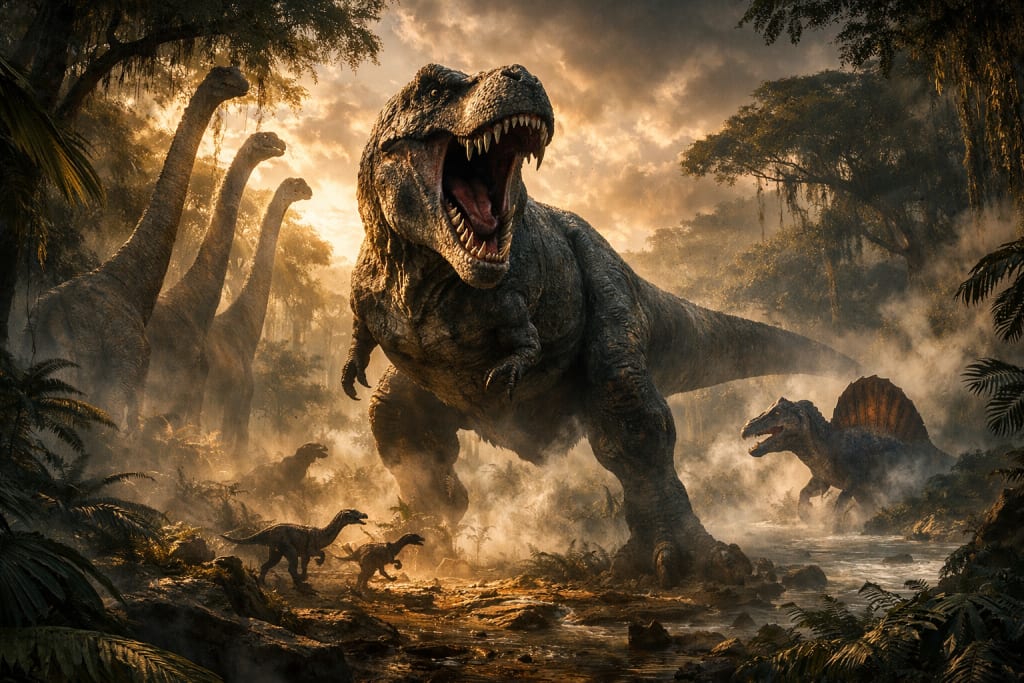
Imagine stepping into a misty prehistoric jungle where the ground trembles beneath your feet. Towering conifers and giant ferns stretch toward the sky, forming a dense green canopy under a warm, humid climate. Strange sounds echo through the forest—deep roars, snapping branches, and the distant thunder of massive footsteps. In this ancient world, survival is a constant struggle.
This was the Mesozoic Era, the age when dinosaurs ruled the Earth.
For nearly 180 million years, dinosaurs dominated the planet’s land ecosystems. From towering plant-eaters that moved like living mountains to terrifying predators capable of crushing bone with a single bite, these creatures shaped the balance of life in prehistoric jungles.
Apex Predators of the Dinosaur World
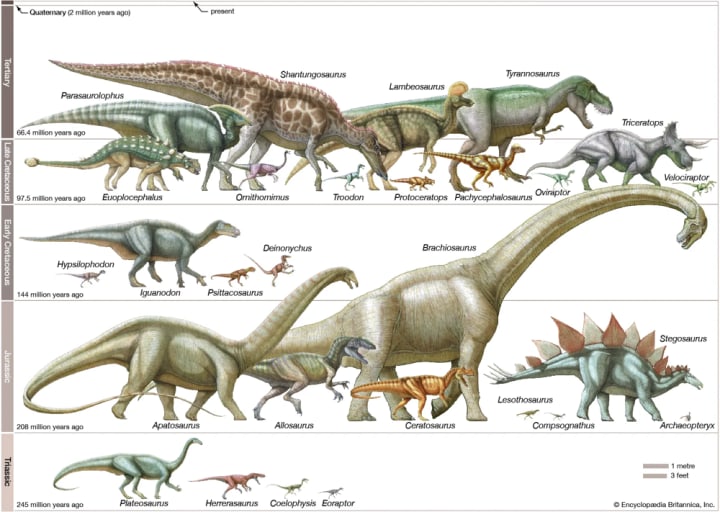
Among the most feared hunters was Tyrannosaurus rex, a gigantic carnivore that could grow over 40 feet long. Despite its tiny forelimbs, it possessed an enormous skull filled with thick, serrated teeth capable of crushing bone.
With powerful legs and exceptional senses, this predator could detect prey from far away. Its binocular vision allowed accurate attacks, while its powerful jaws could shatter even the strongest bones of herbivorous dinosaurs.
Another terrifying predator was Spinosaurus, the largest known carnivorous dinosaur. Growing over 45 feet long, it had a massive sail on its back and adaptations for swimming. Scientists believe it hunted giant fish in rivers and swamps, making it one of the few semi-aquatic dinosaurs.
In South America, Giganotosaurus roamed vast prehistoric landscapes. This enormous predator may have hunted gigantic plant-eaters such as Argentinosaurus, one of the largest dinosaurs ever to exist.
Together, these carnivores stood at the top of the prehistoric food chain.
Armored Giants and Their Defenses
Yet dinosaurs were not helpless prey.
Many plant-eating species evolved incredible defenses to survive attacks.
One famous example is Stegosaurus, recognizable by the large plates along its back and deadly tail spikes. These spikes, sometimes called the “thagomizer,” could seriously injure predators.
Another heavily armored dinosaur was Triceratops, which possessed massive horns and a protective frill. Paleontologists believe it could charge attackers with powerful force, using its horns like natural spears.
Some dinosaurs, such as ankylosaurs, developed full body armor and even tail clubs strong enough to break bones.
Meanwhile, enormous long-necked giants like Brachiosaurus relied on sheer size. Weighing tens of tons, these creatures were so massive that few predators dared to challenge fully grown adults.
What Dinosaurs Ate
Dinosaurs filled nearly every dietary role in prehistoric ecosystems.
Carnivores were primarily theropods with sharp teeth and powerful claws designed for hunting.
Herbivores evolved special adaptations for eating plants. Many species, such as hadrosaurs, had hundreds of grinding teeth to process tough vegetation, while giant sauropods swallowed plants whole and relied on large digestive systems to break them down.
Some dinosaurs were likely omnivores. The small, bird-like Troodon may have eaten fruits, seeds, and small animals. These flexible diets helped stabilize prehistoric ecosystems.
The Rise of Dinosaurs
Dinosaurs first appeared during the Triassic Period, when Earth’s continents were joined together as a giant landmass known as Pangaea.
Over millions of years, dinosaurs diversified across the Jurassic Period and Cretaceous Period.
During this time, flowering plants evolved and spread across the planet, creating new ecosystems. Dinosaurs adapted to these environments, becoming the dominant land animals of their era.
The Catastrophe That Ended an Empire
About 66 million years ago, everything changed.
A massive asteroid struck Earth near what is now the Chicxulub Crater in modern-day Yucatán Peninsula.
The impact released energy equivalent to billions of atomic bombs. Dust and debris filled the atmosphere, blocking sunlight and causing global temperatures to drop dramatically.
Plants died, food chains collapsed, and ecosystems across the planet were devastated.
This event triggered the Cretaceous–Paleogene extinction event, wiping out nearly 90% of species on Earth—including all non-avian dinosaurs.
Only one lineage survived: birds.
A World After Dinosaurs
With dinosaurs gone, new opportunities opened for other life forms.
Small mammals that had once lived in the shadows began to diversify and grow larger. Over millions of years, they evolved into countless species—including the ancestors of humans.
Ironically, the extinction that destroyed the dinosaur empire also made the modern world possible.
Without that asteroid strike, Earth might still belong to giant reptiles instead of humanity.
About the Creator
Keep reading
More stories from imtiazalam and writers in History and other communities.
438 Days Between Life and the Endless Sea
The morning began like any other. The sea near the coast of Mexico was calm, the sky pale with early sunlight, and the air carried that familiar salty scent fishermen know so well. For José Salvador Alvarenga, it was just another fishing trip — another day to earn a living.
By imtiazalam4 days ago in History
The Middle East Question: Power, Peace, and Double Standards
The Middle East Question: Power, Peace, and Double Standards In recent years, the conflict in the Middle East has once again raised serious questions about global politics, justice, and the meaning of peace. Many observers around the world ask the same question: if powerful countries speak so often about peace and human rights, why did they remain silent when violence and suffering were happening earlier?
By Wings of Time 7 days ago in History
Why Didn't Anyone Tell Us
Men, move along. This is not for you. This is for the women. I was forty-five when I began menopause. It is pretty young for that to be going on in a woman’s life, but I had undiagnosed PCOS, my entire life. Thank you to all the gynecologists I had seen my entire life. That in itself should encourage women to keep seeking second opinions, especially when you are not getting correct answers or any at all.
By Alexandra Grant3 days ago in Humans




Comments
There are no comments for this story
Be the first to respond and start the conversation.