
The Munshi Whom Even Kings Admired
A Glimpse into the Life and Influence of the Scholarly Scribes Who Shaped Courts and Kingdoms

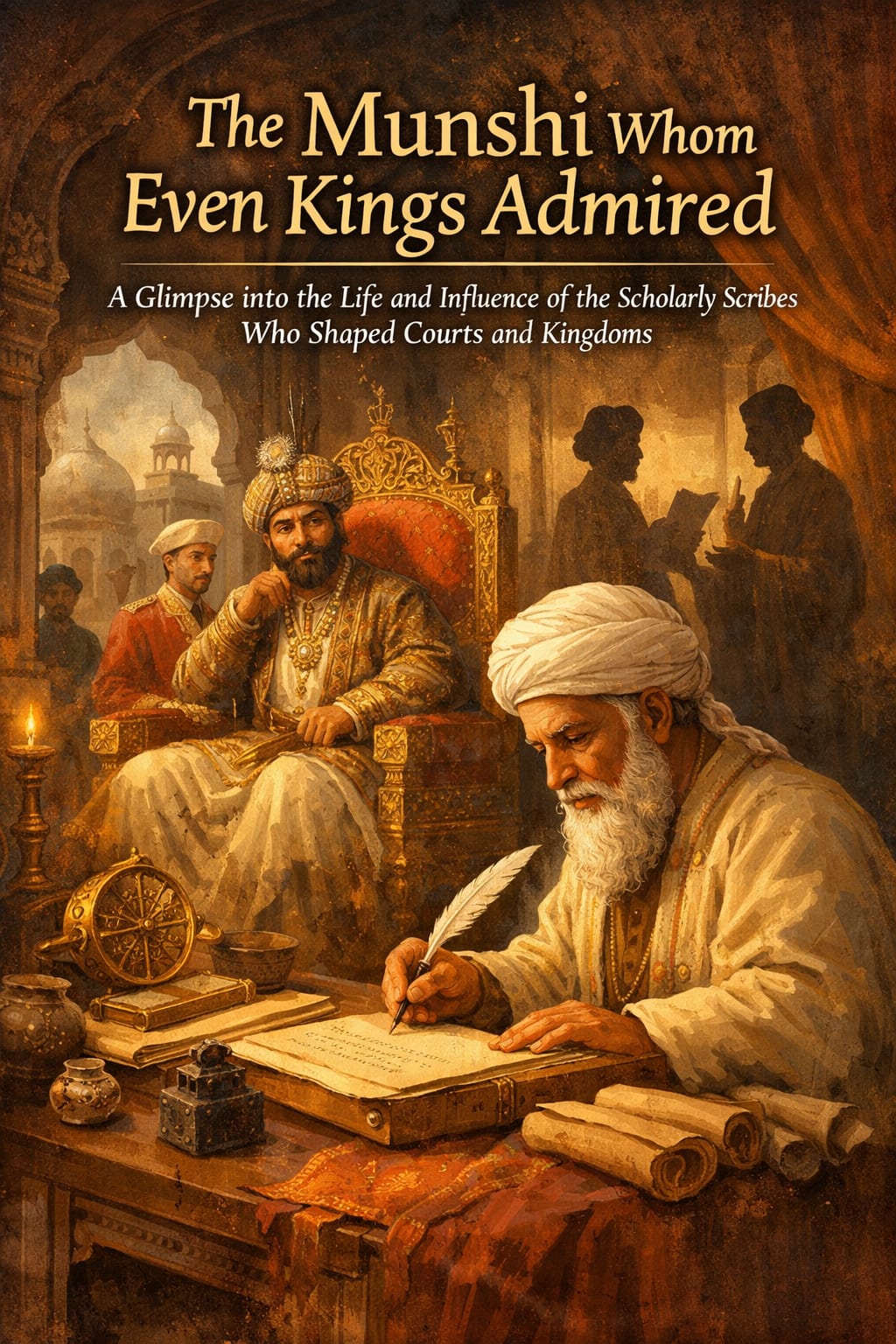
Throughout history, the power of knowledge has often stood quietly beside the power of the throne. While kings ruled with authority and armies, there were individuals whose influence came not from swords but from words. Among them were the Munshis—scholarly scribes, advisors, and masters of language—whose intellect and skill earned them admiration even from the most powerful rulers.
The word Munshi traditionally referred to a learned person skilled in writing, administration, and correspondence. In the courts of South Asia, particularly during the Mughal and later colonial periods, Munshis played a vital role in governance. They were experts in languages such as Persian, Arabic, and later Urdu and English. Their mastery of language enabled them to draft royal decrees, diplomatic letters, treaties, and official records with elegance and precision.
However, a Munshi was far more than a mere clerk. He was often a trusted confidant of the ruler. Kings depended on Munshis to translate complex ideas into refined language and to manage communication between kingdoms, officials, and foreign envoys. In an era when written correspondence carried enormous political weight, the words chosen by a Munshi could shape alliances, prevent wars, or establish new policies.
One of the reasons Munshis were so respected was their deep education. Many spent years studying literature, philosophy, history, and calligraphy. Persian literature, in particular, was considered the language of administration and culture in many royal courts. A Munshi needed not only technical writing skills but also a strong understanding of etiquette, diplomacy, and political nuance. Every letter written on behalf of a ruler had to reflect dignity, intelligence, and authority.
Because of this expertise, some Munshis gained remarkable prestige. Their literary style became famous, and their writings were admired even outside the court. In certain cases, kings themselves praised the elegance of a Munshi’s pen. The beauty of their calligraphy, the depth of their vocabulary, and the wisdom reflected in their words elevated them to a status that few scholars could achieve.
Moreover, Munshis often acted as cultural bridges. During periods of political change—such as the transition from Mughal to British influence—Munshis helped navigate new administrative systems. Their ability to understand multiple languages and cultures made them indispensable intermediaries between rulers and emerging colonial authorities. Many British officials even hired Munshis to learn local languages and customs.
The respect given to Munshis also reflected a broader cultural appreciation for scholarship. In traditional societies, knowledge was considered a form of power. A skilled writer could preserve history, interpret laws, and advise rulers with wisdom. While generals commanded armies, Munshis commanded the written word—a force capable of influencing minds and shaping legacies.
Another remarkable aspect of these scholars was their humility. Despite working close to the throne, many Munshis lived modest lives dedicated to study and teaching. Some became renowned educators who trained future generations of writers and administrators. Their students carried forward the traditions of refined language, disciplined thinking, and ethical conduct.
Today, the role of the Munshi may seem distant from modern bureaucratic systems, but their legacy remains significant. The administrative traditions, literary styles, and diplomatic language developed by these scholars continue to influence South Asian writing and governance. The Urdu and Persian prose styles perfected by Munshis are still admired by linguists and historians.
In a world increasingly driven by technology and rapid communication, the story of the Munshi reminds us of the timeless value of thoughtful expression. Words have the power to build understanding, guide leadership, and preserve civilization. The scholars who mastered this craft demonstrated that intellectual excellence can command respect even from those who hold the highest political authority.
Thus, the Munshi stands as a symbol of the enduring partnership between knowledge and power. While kings may rule kingdoms, it is often the wisdom of scholars that shapes how those kingdoms are remembered. And in many royal courts of history, the quiet brilliance of a Munshi earned admiration not only from the people—but from the kings themselves.
About the Creator
Irshad Abbasi
Ali ibn Abi Talib (RA) said 📚
“Knowledge is better than wealth, because knowledge protects you, while you have to protect wealth.
Keep reading
More stories from Irshad Abbasi and writers in History and other communities.
The Economic Cost of Empire: How British Rule Drained India’s Wealth
For nearly two centuries, the Indian subcontinent remained under British colonial rule. From the mid-18th century until 1947, British policies reshaped India’s political, social, and economic systems. While the British administration introduced railways, legal systems, and modern institutions, historians and economists widely argue that colonial rule resulted in a massive transfer of wealth from India to Britain. This economic extraction has often been described as the “drain of wealth,” a concept that attempts to estimate how much financial loss India experienced during colonial rule.
By Irshad Abbasi about 12 hours ago in History


Comments
There are no comments for this story
Be the first to respond and start the conversation.