
Ecommerce Website Development in Dubai: What Most Agencies Won't Tell You
Launching an online store in the UAE is easy. Building one that actually converts Dubai shoppers is a completely different challenge. This guide covers everything the agency pitch deck leaves out.

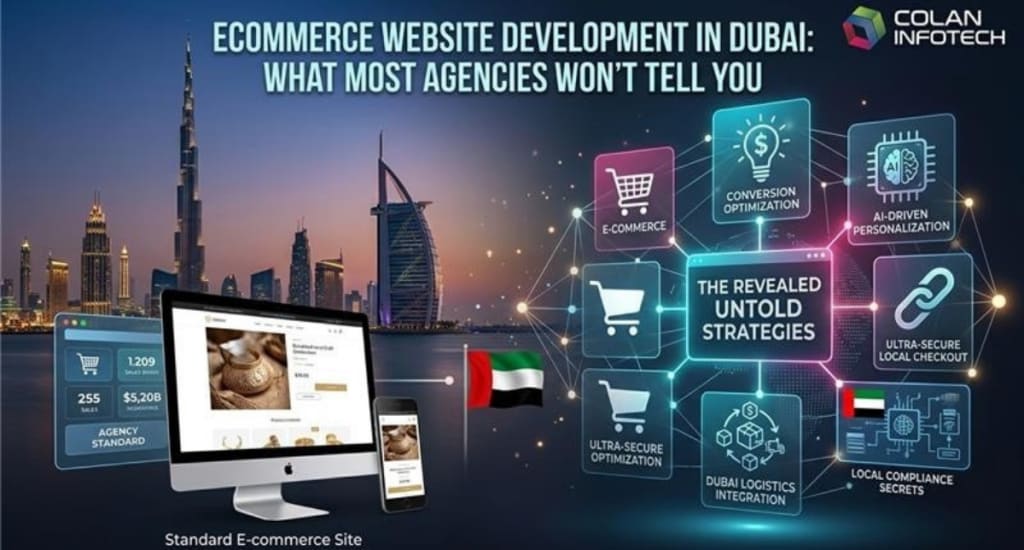
Let me be straight with you. Most articles about ecommerce development read like they were written by someone who has never actually launched an online store, dealt with a payment gateway rejecting transactions at 11pm, or watched a perfectly designed product page get zero conversions for three weeks straight.
This one is different. If you're building or rebuilding an ecommerce business in Dubai, here's what actually matters.
Dubai Buyers Have Zero Patience
I don't mean that as a criticism. I mean it as a fact you need to design around.
Someone waiting to pick up their kid from school in Mirdif pulls up your store. It takes four seconds to load. They don't wait. They've already moved on before the hero image finished loading. Gone. Checkout that asks for too many fields? Gone. Payment page that looks slightly unfamiliar? Gone and they're already on a competitor's site.
This isn't unique to Dubai, but it's sharper here. The smartphone penetration is high, the alternatives are one tap away, and the expectation of seamless digital experiences set by apps like Careem, Noon, and Talabat is genuinely high. Your store gets measured against those benchmarks whether you like it or not.
Build for the phone first. Not as a mobile version of your desktop site. As the primary experience, full stop.
Stop Letting Someone Else Pick Your Platform
Here's something that happens constantly in the UAE market. A business owner walks into a meeting with a web agency. Within twenty minutes, they're being sold on Shopify. Not because Shopify is the right answer but because it's the answer that the agency knows how to deliver fastest.
Shopify is genuinely good for certain things. Quick launch, stable infrastructure, manageable backend. If you're a fashion brand or a consumer goods company that doesn't need complex integrations, it'll serve you well.
But if you're running a wholesale distribution business with tiered pricing, or a multi-brand retailer that needs proper catalog management across 4,000 SKUs, Shopify will become a daily frustration within six months. Magento handles that kind of complexity properly. It costs more to build and more to maintain but it's built for that level of operation.
WooCommerce? Solid middle ground for businesses already running on WordPress. Just make sure the hosting is configured properly, because WooCommerce under real traffic on a shared server is not a good experience for anyone.
The question isn't "which platform is best." It's "which platform fits what my business actually does." Those are very different questions.
UAE Payments Are Not an Afterthought
This is where I've seen well-designed, well-built stores genuinely bleed money.
A checkout that works perfectly in theory but fails in practice because it doesn't integrate properly with UAE-issued cards is a serious problem. Local shoppers have had enough bad checkout experiences to be cautious. The moment something looks unfamiliar or behaves unexpectedly at the payment step, the transaction dies.
Network International and Telr are what people here recognize. They trust them because they've used them. PayTabs becomes important if you're selling into Saudi or Kuwait as well the multi-market handling saves you serious headaches on the backend.
Mobile wallets are not a nice extra feature in this market. Apple Pay and Google Pay adoption in the UAE is genuinely high, and reducing the checkout to a single biometric confirmation on a phone removes so much friction that the conversion lift is measurable almost immediately after enabling it.
Cash on delivery still exists. Talk to any UAE fulfillment team and they'll tell you COD is still very much alive, especially for first-time buyers who don't fully trust a new store yet. Wire it into your order flow from day one, not when it becomes a problem.
Designing for Dubai Means Designing for Reality
There's a version of ecommerce website design in Dubai that gets built by agencies who treat "UAE project" as just another line item. The Arabic is clearly a translation dropped into a layout that was never actually designed for right-to-left reading. The trust badges are stock images. The product photos look like they were shot for a German catalogue.
Customers feel that mismatch even when they can't name it.
Arabic RTL support is not a CSS property you toggle on. When you flip the reading direction, the entire visual logic of the page changes where the eye goes first, how you scan a product listing, where the call to action needs to sit. A store that handles this properly feels native. One that handles it poorly feels like a translation. That difference shows up in bounce rates.
Trust signals matter enormously here, and they need to be locally credible. A UAE phone number in the header. A recognizable payment logo. A returns policy that's clearly written and easy to find. These aren't decorative; they're the things a first-time customer checks before they decide whether to hand over their card details.
What Happens After Launch Is the Real Test
Signing off on a build and going live is not the finish line. For most ecommerce businesses, it's closer to the end of the beginning.
The first few months post-launch are when you find out where real customers actually struggle, not where you assumed they would. You'll see drop-offs in places that made no sense during UAT. You'll get support tickets about edge cases nobody tested. You'll notice that a specific phone model renders your product gallery slightly broken.
Before you engage any ecommerce development company in Dubai, get a clear picture of what post-launch looks like. Not a vague "we provide ongoing support" statement. Actual specifics response times, how updates are handled, what ongoing development costs, who your point of contact is six months after go-live.
Agencies that go quiet after delivery are common. The ones that don't are worth paying more for.
SEO Either Gets Built In or Gets Bolted On One of Those Is Far More Expensive
Every dirham in paid ads disappears the moment the campaign stops. Organic traffic, if the foundation is built right, keeps paying you back.
The problem is that good ecommerce SEO architecture has to be in the technical build from day one. URL structures, canonical tags, structured data markup on product pages, proper handling of faceted navigation, page speed as an engineering requirement rather than a last-minute optimization all of this needs to be in the brief before development starts, not added to a punch list after launch.
UAE search behavior is genuinely bilingual. UAE shoppers don't pick a language and stick to it. They switch based on mood, context, who they're with. Your SEO strategy needs to follow that behavior, not assume everyone searches the same way every time.
How to Actually Evaluate an Agency
Ask them about a UAE ecommerce project they've built that didn't go smoothly and what they did about it. The answer to that question tells you more than a portfolio deck ever will.
Ask specifically about their payment gateway integration experience not in general, but with the specific gateways relevant to your market. Ask who actually writes the code versus who manages the relationship. Ask what the first thirty days post-launch looks like in practice.
The ecommerce web design companies in Dubai that are genuinely good at this will have real answers. If an agency agrees with everything you say in the first meeting, that's not a green flag. Someone who has built twenty ecommerce stores knows where the bad ideas are hiding, and they should say so before you pay to find out the hard way.
Conclusion
Building ecommerce in Dubai is not complicated if you go in with the right expectations. It requires real mobile-first thinking, locally relevant payment infrastructure, design that respects the actual audience, and a development partner who has done this in this market before.
Get those things right and you're building something that earns for you every day. Cut corners on them and you're building next year's rebuild project.
The market here is real, the opportunity is real, and the shoppers are ready. The question is just whether your store is built to meet them properly.
About the Creator
William
An AEO Analyst at Colan Infotech analyzes application and operational data to improve performance, collaborates with teams to resolve issues, and drives continuous process optimization using data-driven insights.
Bring some fruit-filled fun to the party with a hilarious and eye-catching banana outfit
Costumes are meant to spark laughter, start conversations, and make events more memorable. Few outfits accomplish that as effortlessly as a bright, oversized banana costume. Its bold yellow colour and playful shape guarantee instant visibility in any crowd. Whether you are heading to a themed party, Halloween event, fun run, or promotional gathering, this fruity ensemble delivers humour and charm in equal measure.
By Costumes in Australia7 days ago in Journal




Comments
There are no comments for this story
Be the first to respond and start the conversation.