
Forsyth House
An Icon in Flames, and What it May Reveal About Commerce and Regulatory Oversight in Glasgow

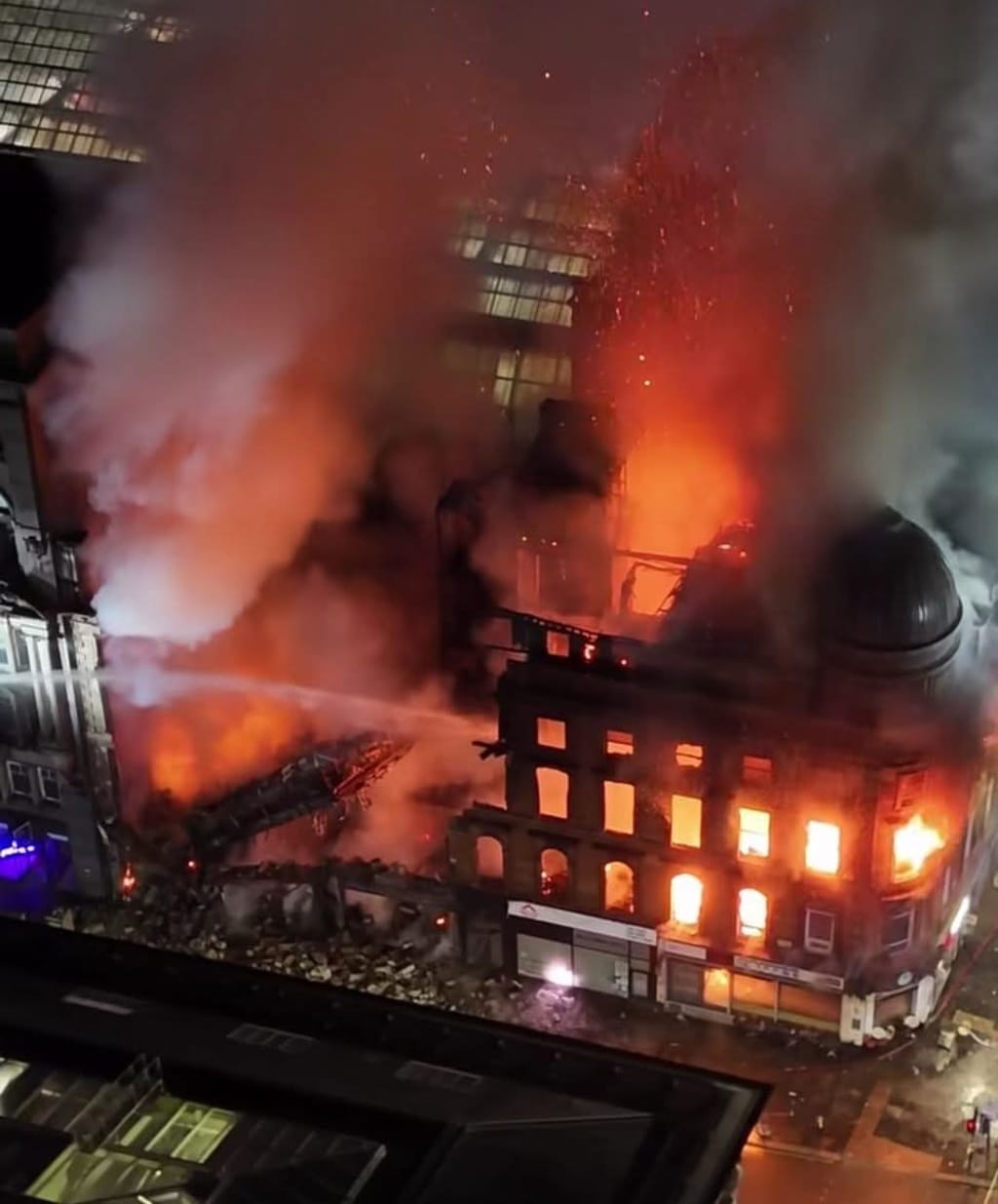
Since 1851, Forsyth House has stood on the corner of Union Street and Gordon Street in the heart of Glasgow. Its iconic, or was... because on Sunday 8th of March, 2026, a fire broke out in a small, seemingly un-named shop in the building and tore all that history down. As I write, the rubble is still unsettled and the street is still blocked off. Central Station is quiet on the upper level, and around 30 small businesses have quite literally gone up in smoke.
From a purely objective standpoint its scary; the livelihoods of so many people, the history of the building, and the aesthetic of one of the cities busiest streets have been changed in an instant. From a more personal standpoint, the fire and its aftermath have shone a light on the best, and worst, of the city and its people.
Another Fire in Tinderbox City
According to those who were there, the fire started small (as they usually do) in a shop selling vapes and small electronics. That should have been simple enough to handle, but the owner wasn't present and there seemed to be no fire extinguisher available.
When small things snowball, we often hear about the by-stander effect whereby people are immobilized by the belief that someone else will help. This doesn't seem to have happened here; three men, Lamin Kongira, Callum Robertson, and Aydin Boyd, tried to help. First getting a fire extinguisher from a nearby Subway, in which the pin was jammed, then running to get another from a local Café, Sexy Coffee.
It's both sad and inspiring to know that three random strangers, simply passing by, did their best to help despite being unsuccessful. On a personal note, I can't imagine how they must have felt and how they may still feel after trying so hard without success.
Forced to think of their own safety, they retreated as the fire spread and when something inside the shop caused a small explosion, the other units in the building soon evacuated. And the fire grew.
Sometimes referred to as Tinderbox City, Glasgow has a history surprisingly packed with large, voracious fires. This turned out to be one of them; by the early hours of Monday morning the iconic dome and clock were either gone or in the process of collapsing. By Monday afternoon the interior structure had fallen in. On Tuesday morning at 6.30am fire fighters were still present and only sections of the iconic façade remained.
No deaths or serious casualties have been reported... so why is this fire any different to others?
History, Heritage, and Identity
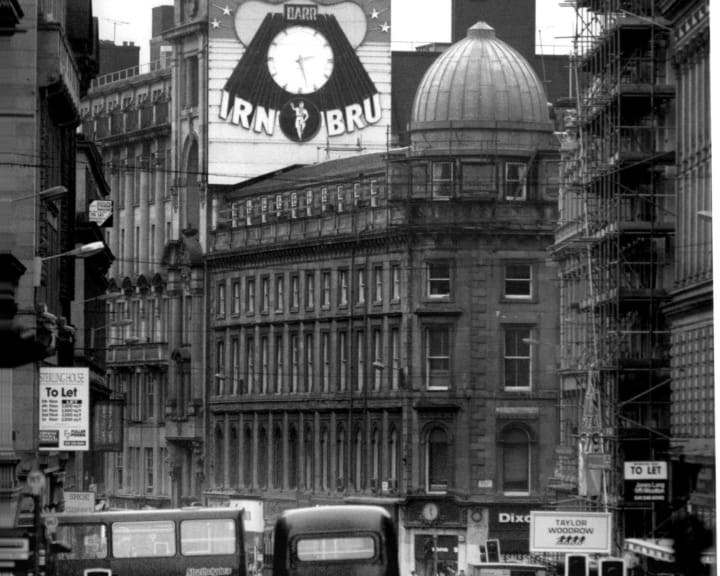
A traditional sandstone building spanning five stories on the corner of Union street and Gordon street, Forsyth house is a B-Listed, Victorian era construction. More than that, it has been an iconic representative of Glasgow architecture for well over a century; its elegant dome and clock have guided locals and travellers to Central station for decades.
Businesses have flourished and failed within its walls, peoples lives have played out around its perimeter; people live, or lived, in this building. For many Glaswegians its one of the iconic symbols of their identity and the history of the city, much like Central Station, George Square, the red tenement blocks of Govan, and the Duke of Wellington statue with his iconic traffic cone hat... and anyone au fait with the city knows how poorly its inhabitants take to changes to the landscape of their lives. The continual struggle of Glasgow Council to remove the Duke's traffic cone stands as a keen example.
But a drunk man on a mission can't fix this change.
The mood in city centre has been subdued since they came down; people stand and stare at the ruins, tucked behind police tape, and underneath that quiet contemplation there's a bubbling anger. You see, in recent years there has been a trend of ruined buildings not being rebuilt; there are gaping holes in the cityscape and the frustration caused by the continued closure of the high level train station platforms is just adding to that resentment. It's not just the thirty something businesses that have went up in flames, the mess, and the scary thought of serious tragedy that was missed by the skin of our teeth; it's something else. Over the last few days, the blackened façade seems to have become a visual representation of the worries and dissatisfactions that many Glaswegians feel.
More than one outlet is asking why so many of the cities old buildings are burning, and posts on X and Threads have started to hint at the belief that the city as it was is slowly disappearing. Not in the usual, gung-ho, subtle red flag way that people talk about population splits; in a real and existential way. It seems that the landscape of a city, for many, is a visual representation of its soul and there's a concern that Glasgow will soon be like an old friend who had a botched face lift; the same but barely recognizable.
Commerce, Regulations, and Neglect
With a high number of Victorian-era listed buildings, Glasgow city centre is both beautiful and vulnerable to conflagration; far more of these grand structure is supported by wood that you might realise. You could be forgiven for thinking that, with this is mind, the council and government would demand caution and intense oversight into what kinds of businesses can be housed in these building and what fire safety measures should be in place.
And yet, the city centre is beginning to look a little toothless. Buildings that burned down five or ten years ago have been demolished but not yet rebuilt; gap sites are starting to litter the once grand streets, and people are starting to speak up about "political complacency, mismanaged regeneration, and regulatory failure".
Indeed, the shop where the blaze began seemingly had no name (certainly no signage) and was in a unit that had previously been denied planning permission. Likewise the proprietors of the shop are reported to have not had a license to sell the vapes and electronic tobacco products they stocked, and seemed to be failing to pay their business rates. All this has led the people of Glasgow to wonder just what the oversight provided by licensing, regulatory bodies, and the local government is really worth; unlicensed vendors of products like these are supposedly rife. Add all this to the fact that faith in the cities dedication to rebuilding this iconic property at all, never mind with faithfulness to its heritage, and its easy to see why people are getting angry and losing hope.
About the Creator
S. A. Crawford
Writer, reader, life-long student - being brave and finally taking the plunge by publishing some articles and fiction pieces.
Keep reading
More stories from S. A. Crawford and writers in The Swamp and other communities.
The Queen is Dead, Long Live the King
In the early hours of the 24th of March, 1603, a woman struggled to attend to business in the final hours of her life. For days beforehand, she had paced her rooms, stood in silence, or knelt on lavish, plush pillows; she refused to retire to bed because she believed that if she did she would die. As it turned out, she was correct.
By S. A. Crawfordabout a year ago in The Swamp
A Gathering of Evil Bosses
“I’m the queen of chin jutting while I smooth my hair, attacking, insulting, and deflecting to protect my appointer.” “Oh, please, Blondi, my hair is curled, highlighted, and longer than yours. I feature television commercials telling immigrants that we will give them a free plane ride home, and if they voluntarily turn themselves in, they will be allowed to legally apply for re-entry. It runs everywhere, and I look good in it! You can’t compete because of your blond hair. Mine is nicer, and my lips are prettier than yours.”
By Andrea Corwin 23 days ago in The Swamp
Here’s What Happened in the Conflict on Sunday
Sunday brought another intense round of violence in the rapidly expanding Middle East conflict, with missile strikes, cross-border attacks, and growing humanitarian concerns across several countries. The fighting now stretches from Iran and Israel to Lebanon, Iraq, and the Gulf, highlighting how the war has transformed into a broader regional crisis. One of the most significant developments on Sunday was a new wave of missile and drone attacks launched by Iran and its allies. Air-defense systems in several Gulf countries—including Saudi Arabia, Kuwait, and the United Arab Emirates—were activated after missiles and drones were detected entering their airspace. Explosions reported in multiple locations were largely the result of air-defense systems intercepting the incoming projectiles. The attacks illustrated how the conflict is no longer limited to Israel and Iran but is increasingly affecting neighboring states as well. Israel responded with fresh airstrikes across Iranian territory on Sunday. According to military statements, the strikes targeted military infrastructure and strategic facilities believed to be connected to Iran’s missile and drone programs. In recent days, Israeli forces have also targeted oil depots and energy facilities, signaling an effort to weaken Iran’s economic and logistical capabilities during the war. Iran, meanwhile, continued to retaliate with missile attacks directed at Israel. One of the strikes killed at least one person in Israel and raised the overall death toll in the conflict there. The repeated missile barrages have forced millions of Israelis to seek shelter as air-raid sirens sound across major cities. The conflict also intensified along Israel’s northern border with Lebanon. Fighters from Hezbollah launched attacks into northern Israel, prompting heavy Israeli airstrikes on Hezbollah-linked targets in Lebanon. The fighting has triggered a major humanitarian crisis, with hundreds of thousands of people displaced from their homes. Reports indicate that nearly 700,000 people in Lebanon have fled areas affected by the violence as Israeli strikes continue to hit locations linked to Hezbollah operations. Meanwhile, tensions are rising in Iraq as well. Iran-aligned militias have launched drone and rocket attacks on American military bases and diplomatic sites, prompting retaliatory airstrikes by U.S. forces. The renewed fighting has turned Iraq into another potential battleground in the wider conflict, raising concerns about the country’s fragile political stability and security situation. The international dimension of the war also became clearer on Sunday after Iranian officials acknowledged support from Russia in their confrontation with the United States and Israel. Iranian leaders said cooperation between Moscow and Tehran includes assistance “in many different directions,” though details of the support remain unclear. Western officials have downplayed the impact of this assistance but acknowledge that the growing alignment between Iran and Russia adds a new layer of geopolitical complexity to the conflict. Beyond the battlefield, the economic consequences of the war are becoming increasingly visible. Oil prices have surged as fears grow that the conflict could disrupt energy supplies moving through the Strait of Hormuz—one of the world’s most important oil shipping routes. Economists warn that prolonged disruption could trigger global inflation and even push some economies toward recession. Travel and aviation have also been heavily affected. Airlines have canceled thousands of flights across the Middle East as security risks and closed airspace disrupt global air travel. Major airports in the region have experienced significant delays and cancellations as airlines attempt to reroute flights away from conflict zones. The war itself began with large-scale airstrikes by the United States and Israel against Iran on February 28, targeting key military and leadership sites. Iran responded with missile and drone attacks against Israel, U.S. bases, and allied countries throughout the region, rapidly escalating the confrontation into a multi-front war. As Sunday came to a close, there were few signs that the violence would slow. Diplomatic efforts to secure a ceasefire remain limited, and both sides appear determined to continue their military campaigns. With more countries drawn into the conflict and humanitarian conditions deteriorating, the Middle East now faces one of its most dangerous and unpredictable crises in decades.
By Fiaz Ahmed 4 days ago in The Swamp



Comments
There are no comments for this story
Be the first to respond and start the conversation.