
No Nobles Day: Britain’s Parliament Boots Its Last Hereditary Lords After 700 Years
A historic reform ends centuries of aristocratic privilege in the House of Lords, marking a dramatic transformation in the United Kingdom’s political system.
A Historic Day for British Democracy
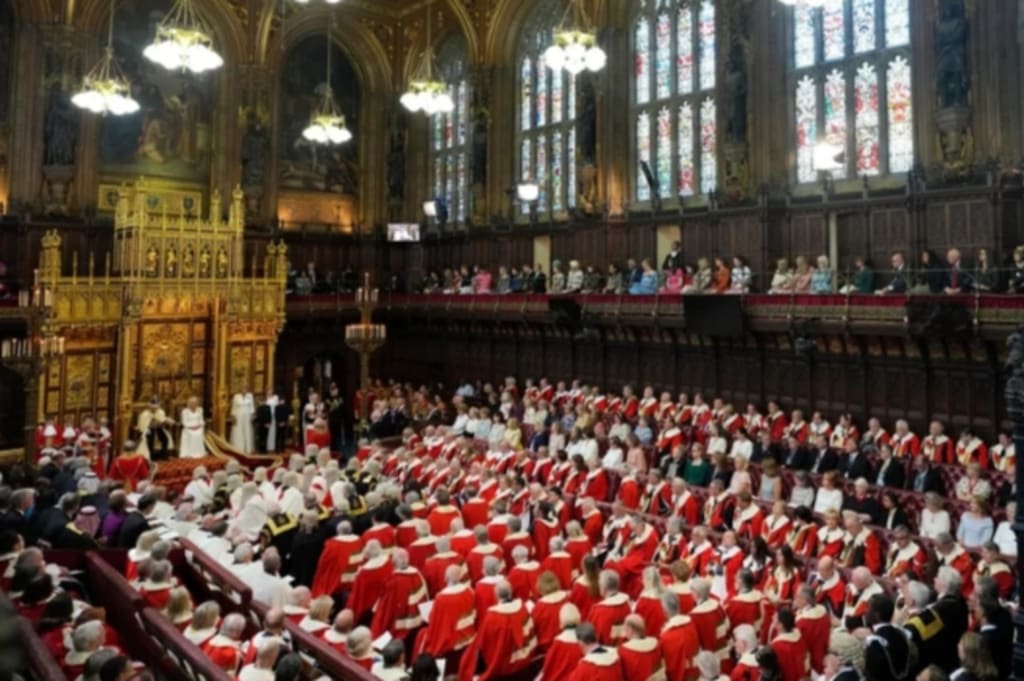
After more than seven centuries of aristocratic influence, the Parliament of the United Kingdom has taken a historic step by removing the final hereditary peers from the House of Lords.
The moment has been widely referred to as “No Nobles Day,” symbolizing the end of a long era in which individuals could sit in the nation’s legislature simply because of their family lineage. The reform effectively eliminates the last remaining seats reserved for hereditary nobles — members of aristocratic families who inherited their titles and parliamentary roles.
Supporters of the move say it brings the United Kingdom closer to a fully modern democratic system, while critics argue it removes centuries-old traditions that helped shape the country’s political identity.
Regardless of opinion, the decision marks one of the most significant constitutional changes in Britain in decades.
The Long History of Hereditary Power
For most of Britain’s history, political authority was closely tied to aristocratic titles. Nobles such as dukes, earls, viscounts, and barons historically held positions in the House of Lords because of their hereditary status.
The chamber itself dates back to medieval times when monarchs relied on influential nobles and church leaders to advise on governance.
Over the centuries, the House of Lords evolved into a legislative body responsible for reviewing laws passed by the House of Commons.
While the Commons became the primary democratic chamber, the Lords maintained significant power as a revising and scrutinizing institution.
For generations, hereditary peers occupied hundreds of seats in the chamber, making aristocratic influence a defining feature of British politics.
Reform That Began Decades Ago
The removal of the final hereditary peers is the culmination of reforms that began in the late 20th century.
In 1999, the House of Lords Act 1999 dramatically reduced the number of hereditary members allowed to sit in the chamber. The act removed most hereditary peers but allowed 92 of them to remain temporarily as part of a compromise agreement.
For years, those remaining members continued to serve while political leaders debated the future of the chamber.
Many reform advocates argued that allowing hereditary legislators in a modern democracy contradicted the principle that lawmakers should be selected based on merit or democratic legitimacy rather than birth.
The latest reform finally completes the process that began more than two decades ago.
What Happens to the House of Lords Now?
With the hereditary seats abolished, the House of Lords will now consist primarily of life peers — individuals appointed for their expertise, experience, or public service.
Life peers are nominated by the government or independent commissions and hold their titles only for the duration of their lifetime, meaning their positions cannot be inherited by their descendants.
This system allows individuals from diverse professional backgrounds — including academia, science, business, law, and public service — to participate in legislative review.
Supporters say this approach creates a more knowledgeable and balanced chamber that reflects modern British society.
Political Reactions to “No Nobles Day”
The reform has generated strong reactions across the political spectrum.
Many lawmakers celebrated the decision as a milestone for democracy, arguing that no one should have a legislative role solely because of their ancestry.
They believe the change strengthens the legitimacy of Parliament and aligns the United Kingdom with other democratic systems around the world.
However, some critics expressed concern about losing a unique element of British constitutional tradition.
Hereditary peers often saw themselves as independent voices in the chamber, sometimes challenging governments without concern for political careers or electoral pressures.
Opponents of the reform worry that removing them could reduce the diversity of perspectives within the House of Lords.
A Symbolic Break with the Past
Beyond the practical effects on governance, the end of hereditary seats carries powerful symbolic meaning.
For centuries, aristocratic titles represented social status, privilege, and influence in British society.
Although many hereditary peers had already lost their direct political power over the years, the presence of nobles in Parliament remained a visible reminder of the country’s historical class system.
The decision to remove the last hereditary members reflects broader cultural shifts toward equality and merit-based leadership.
It also underscores how even deeply rooted traditions can evolve in response to modern expectations about democracy and fairness.
The Future of Lords Reform
While this change is historic, it may not be the final step in reforming the House of Lords.
For decades, politicians and constitutional experts have debated whether the chamber should become fully elected.
Some argue that an elected upper house would increase democratic accountability, while others warn that it could create conflicts with the House of Commons.
Currently, the House of Lords functions as a revising chamber, meaning it reviews legislation and suggests amendments rather than directly controlling government policy.
Many observers believe this structure works best when members are appointed for expertise rather than political competition.
As a result, the debate over how far reform should go remains unresolved.
A Turning Point in British Governance
“No Nobles Day” represents a significant turning point in the evolution of the British political system.
The removal of hereditary peers demonstrates how institutions that once defined a nation’s governance can gradually adapt to changing societal values.
While the House of Lords still retains traditions dating back centuries, its composition now reflects a modern approach that prioritizes experience and public service over inherited privilege.
For historians, the moment marks the end of one of the longest-running political customs in the Western world.
Conclusion
The decision by Britain’s Parliament to remove the last hereditary peers after 700 years is both historic and symbolic.
It signals the end of aristocratic inheritance as a pathway to legislative power and reinforces the idea that democratic institutions must evolve with the societies they serve.
While debates about the future of the House of Lords will continue, one thing is certain: the age of hereditary lawmakers in Britain has finally come to an end.
In doing so, the country has closed a remarkable chapter in its political history — one that stretches back to the medieval roots of its parliamentary system.
About the Creator
Parallel Protests
I haven't written for quite some time, but I have A LOT of thoughts about yesterday's protest rally against our government's involvement and complicity in America's war on Iran, on the harbourside of my home city Bristol, and I need to put them somewhere. My gorgeous girlfriend is always a loving and listening ear and sharing it all with her will always be a healthy and happy way of processing the mental and emotional weight, but getting it straight in my brain to share means writing it all down in straight lines, so, here we are and thanks for being here.
By Steph Cole9 days ago in The Swamp
Jesse Jackson Funeral: A Nation Mourns a Civil Rights Icon
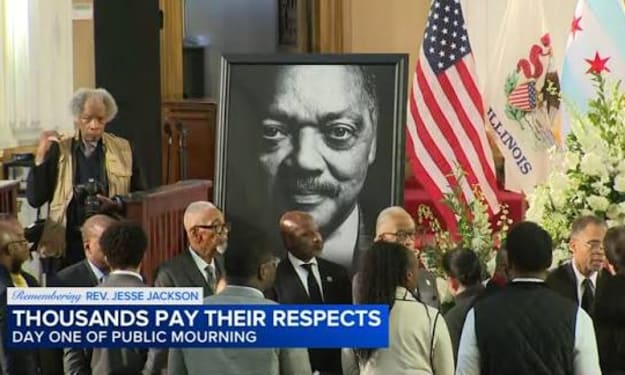
The United States and the world are bidding farewell to Rev. Jesse Jackson Sr., a towering figure in the civil rights movement whose decades of advocacy reshaped American politics and social justice. The funeral services, held this week in Chicago, Illinois, have drawn a remarkable outpouring of respect, drawing former U.S. presidents, dignitaries, artists, activists, and thousands of ordinary citizens who came to pay their final respects. Jackson, who died on February 17, 2026, at age 84, had been receiving tributes nationwide for his lifelong commitment to equality, voting rights, economic justice, and human rights. Before the Chicago services, his body lay in state in South Carolina, his birthplace, where he became only the second Black person to receive that honor at the state capitol. A Week of Remembrance The events began weeks ago with memorials in several U.S. cities. Thousands lined up at the South Carolina Statehouse in Columbia to pay tribute, recalling Jackson’s early activism in desegregation protests and his pivotal role alongside leaders like Dr. Martin Luther King Jr. On March 6, 2026, the main public “Homegoing” service — dubbed “The People’s Celebration” — took place at the House of Hope church on Chicago’s South Side. The service was open to the public, with doors opening early in the morning to accommodate crowds. The ceremony was also livestreamed for viewers across the country. Notable figures who attended included former U.S. Presidents Bill Clinton, Barack Obama, and Joe Biden, as well as former First Lady Dr. Jill Biden and former Secretary of State Hillary Clinton. In addition to political leaders, the service featured performances by Chicago‑born singer Jennifer Hudson, gospel stars Bebe Winans and Pastor Marvin Winans, and remarks from local officials including Chicago Mayor Brandon Johnson and Illinois Governor J.B. Pritzker. Honoring a Legacy Jackson’s life was deeply rooted in the civil rights movement. Born in Greenville, South Carolina, in 1941, he first gained national attention as a young activist demanding access for Black citizens to public libraries in the segregated South. He went on to march in Selma, Alabama, with King and other leaders and became an influential voice for justice and equality for decades. Beyond his early civil rights work, Jackson made history as a two‑time Democratic presidential candidate in 1984 and 1988, energizing voters and championing issues such as economic opportunity, voter registration, and social reforms. His campaigns helped expand the influence of progressive politics and build broader coalitions in American elections. He also founded the Rainbow PUSH Coalition, a Chicago‑based organization dedicated to civil rights, educational equity, economic justice, and social change. Under his leadership, the coalition pressured corporations to diversify hiring and supported initiatives that improved opportunities for marginalized communities across the United States. Global Recognition and Tributes Jackson’s impact extended beyond the United States. Leaders from other countries acknowledged his contributions, including a delegation sent by Nigerian President Bola Ahmed Tinubu to deliver condolences and honor Jackson’s legacy of fighting apartheid and advocating for global human rights. Flags were lowered to half‑staff in cities such as Montgomery, Alabama, as communities across the nation paused to remember his contributions, while local transit services adjusted operations to help mourners attend the funeral services in Chicago. Final Resting Place and Reflection After the public Homegoing service, a private homegoing event was planned for March 7 at the Rainbow PUSH Coalition headquarters, followed by burial at Oak Woods Cemetery—one of Chicago’s historic resting places that already houses prominent figures such as journalist Ida B. Wells‑Barnett and Olympian Jesse Owens. Observers noted that Jackson’s burial among these icons of courage and achievement was fitting, celebrating a life dedicated to opening doors and breaking barriers. Many mourners spoke of Jackson’s powerful message of hope and human dignity, citing his enduring belief that progress is possible even in the face of systemic injustice. A Legacy Beyond the Ceremony As the nation reflects on the life of Rev. Jesse Jackson, many commentators emphasize that his legacy will live on in movements for equality, justice, and civic engagement. His influence on American political life, civil rights advocacy, and community empowerment has shaped the course of history — and his words and deeds continue to inspire activists and ordinary citizens alike. KPBS Public Media For many, Jackson’s life was more than a chapter in history; it was a call to action — one that still resonates as leaders and communities seek to build a more just and equitable society.
By Fiaz Ahmed 6 days ago in The Swamp



Comments
There are no comments for this story
Be the first to respond and start the conversation.