
Anti-Venom Market Size & Forecast 2025–2033
Rising Snakebite Incidents and Advancements in Biotechnology Drive Global Demand for Life-Saving Antivenom Therapies

Global Anti-Venom Market Outlook
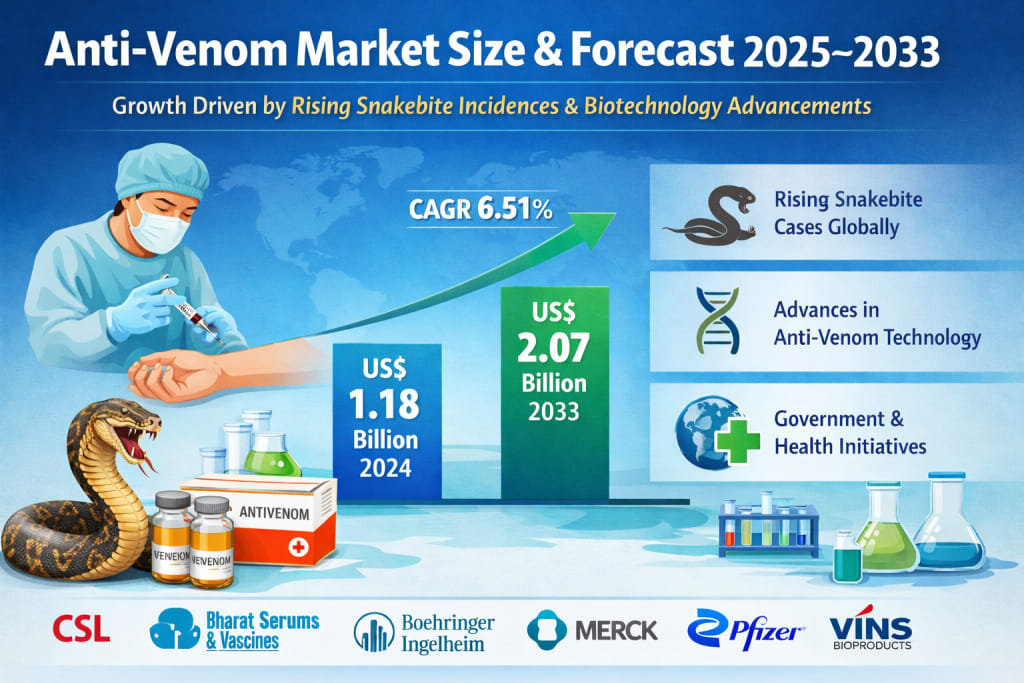
The global anti-venom market continues to gain momentum as governments, pharmaceutical companies, and public health organizations intensify efforts to address the growing threat of venomous animal bites. According to market estimates, the global anti-venom market was valued at approximately US$ 1.18 billion in 2024 and is projected to expand at a compound annual growth rate (CAGR) of 6.51% between 2025 and 2033, reaching around US$ 2.07 billion by 2033.
This steady growth is driven by a combination of factors, including increasing snakebite cases worldwide, advances in antivenom manufacturing technologies, and improved healthcare accessibility in developing regions. As snakebite envenoming continues to pose a serious health risk in many parts of the world—especially in tropical and subtropical regions—demand for effective treatment solutions is expected to grow significantly over the coming decade.
Understanding Anti-Venom and Its Importance in Healthcare
Anti-venom, often referred to as antivenin, is a biological medical product designed to counteract toxins injected by venomous animals such as snakes, spiders, and scorpions. It is typically produced by immunizing animals—commonly horses or sheep—with small, controlled doses of venom. The animals develop antibodies that neutralize the toxins, and these antibodies are later extracted and purified to create antivenom treatments.
When administered promptly after a venomous bite or sting, antivenom can effectively neutralize harmful toxins circulating in the bloodstream. This significantly reduces the risk of severe complications such as organ failure, paralysis, or death.
The significance of antivenom therapies cannot be overstated. The World Health Organization has recognized snakebite envenoming as a neglected tropical disease, highlighting the urgent need for wider access to affordable and effective treatments. In many rural communities, particularly in Asia, Africa, and Latin America, antivenom remains the only life-saving treatment available for snakebite victims.
Rising Global Incidence of Snakebites
One of the major drivers of the anti-venom market is the increasing incidence of snakebites worldwide. Each year, millions of people suffer from venomous snakebites, with a large proportion occurring in agricultural and rural areas.
Farmers, field workers, and individuals living near forests or wilderness regions face a higher risk of encounters with venomous animals. In countries with tropical climates, the prevalence of species such as cobras, vipers, and kraits significantly contributes to snakebite cases.
In regions such as South Asia and Sub-Saharan Africa, snakebites often occur in areas with limited access to healthcare facilities. This situation has pushed governments and international health agencies to expand antivenom availability and strengthen emergency response infrastructure.
Growing awareness campaigns, improved surveillance systems, and expanded distribution of antivenom treatments are helping mitigate mortality rates while simultaneously increasing demand in the global market.
Technological Advancements in Anti-Venom Development
Modern biotechnology is playing a crucial role in improving the effectiveness and safety of antivenom therapies. Traditionally produced using animal-derived antibodies, newer research is focusing on recombinant antibodies, monoclonal antibody therapies, and synthetic antivenoms.
These advanced approaches aim to reduce allergic reactions and improve treatment precision. Scientists are also working on broad-spectrum antivenoms capable of neutralizing venom from multiple species, which could significantly improve treatment outcomes in regions with diverse snake populations.
Improved purification processes, better venom characterization, and advances in immunology have also enhanced the quality and efficacy of modern antivenom products. Pharmaceutical companies are increasingly investing in research collaborations with universities and research institutes to accelerate innovation.
Government Initiatives and Global Health Programs
Government programs and international collaborations have played an essential role in expanding access to antivenom therapies.
Several countries have launched initiatives aimed at reducing snakebite mortality through improved treatment accessibility and healthcare infrastructure. These initiatives often involve partnerships with pharmaceutical manufacturers, research institutions, and global health organizations.
For example, efforts to improve antivenom development and distribution in India have led to collaborations between pharmaceutical companies and research institutes. Such initiatives aim to develop more effective region-specific antivenoms capable of targeting local snake species.
Public health campaigns have also helped educate communities about preventive measures, first-aid responses, and the importance of seeking immediate medical treatment after a venomous bite.
Leading Companies in the Anti-Venom Market
The global anti-venom market features a mix of pharmaceutical giants, biotechnology firms, and specialized biologics manufacturers. These organizations focus on developing life-saving therapies through advanced research and large-scale production capabilities.
Bharat Serums and Vaccines Limited
Founded in 1971 and headquartered in India, Bharat Serums and Vaccines Limited (BSV) is a leading biopharmaceutical company known for its injectable drugs, serums, and vaccines.
The company operates advanced manufacturing facilities that comply with international regulatory standards. BSV is heavily involved in research and development, focusing on biotechnology-driven therapies that address critical healthcare challenges. Its products are exported to more than 100 countries, making it a significant contributor to global healthcare solutions.
Boehringer Ingelheim International GmbH
Established in 1885 and headquartered in Germany, Boehringer Ingelheim is a globally recognized pharmaceutical company involved in the development of medicines, vaccines, and biopharmaceutical therapies.
The company’s portfolio includes treatments for central nervous system disorders, respiratory diseases, oncology, and animal health. With a strong research foundation and global manufacturing presence, Boehringer Ingelheim contributes to the advancement of biologic treatments, including therapies related to venom-induced conditions.
Boston Scientific Corporation
Boston Scientific, founded in 1979 in the United States, is a medical technology company that develops devices used in various interventional medical specialties.
Its technologies support treatments across cardiology, neurology, pulmonology, gastroenterology, and vascular medicine. While primarily focused on medical devices, the company’s innovations play a role in improving emergency medical interventions and hospital treatment capabilities for venom-related injuries.
CSL Limited
Founded in 1916 and headquartered in Australia, CSL Limited is one of the world’s leading biotechnology companies specializing in plasma-derived therapies and vaccines.
CSL’s research platforms include recombinant protein technology, gene therapy, and advanced biologics manufacturing. The company focuses on treatments for immune deficiencies, hematological conditions, and infectious diseases, contributing to broader innovations in biologic therapies.
Merck & Co., Inc.
Merck & Co., established in 1891 in the United States, is a global pharmaceutical company involved in developing medicines, vaccines, and biologic treatments.
Its extensive research infrastructure and global distribution network allow the company to deliver innovative therapies addressing infectious diseases, oncology, and immunology. Merck’s technological expertise and large-scale manufacturing capabilities support the development of advanced biological treatments, including therapies relevant to venom neutralization.
Product Launches and Strategic Collaborations
Recent developments in the anti-venom market highlight growing innovation and strategic partnerships among industry players.
In September 2024, VINS Bioproducts Limited continued expanding its global reach as a major manufacturer of immunoglobulins and antisera used to treat snake and scorpion bites. With two advanced manufacturing facilities and a large equine farm, the company supplies its products to over 70 countries worldwide.
Another notable development occurred in August 2022, when Bharat Serums and Vaccines partnered with the Indian Institute of Science (IISc) to develop improved antivenom therapies tailored for snake species found in India. This collaboration aims to enhance treatment effectiveness and reduce snakebite mortality across the country.
These partnerships demonstrate the importance of cross-sector collaboration in developing innovative therapies and improving treatment accessibility in regions where venomous bites remain a serious public health concern.
Industry Developments and Research Breakthroughs
The anti-venom industry has also witnessed several strategic developments designed to strengthen supply chains and improve treatment availability.
In June 2024, MicroPharm Limited announced the acquisition of Sanofi Pasteur’s equine immunoglobulin antivenom product range, including Viperfav®, Bothrofav®, and Scorpifav®. This acquisition allows MicroPharm to transfer production to its manufacturing facilities in Wales and expand distribution to markets with high demand.
The company also plans to relaunch antivenom products such as Fav-Afrique® and Favirept® across African and Middle Eastern markets, where effective antivenom treatments remain limited.
Meanwhile, biotechnology company Ophirex Inc. received U.S. FDA Fast Track designation in March 2022 for varespladib-methyl, a promising treatment for snakebite envenoming. The drug aims to neutralize venom toxins rapidly and could potentially revolutionize snakebite treatment.
Sustainability Initiatives in Biopharmaceutical Production
Sustainability is becoming increasingly important in the biotechnology and pharmaceutical sectors. Several institutions involved in antivenom production are integrating environmentally responsible practices into their operations.
The Butantan Institute in Brazil focuses on sustainable biomedical innovation by reducing energy consumption, minimizing waste, and promoting responsible laboratory practices. The institute also invests in renewable energy infrastructure and environmental conservation initiatives while expanding access to vaccines and antivenoms.
Similarly, South African Vaccine Producers (SAVP) prioritizes sustainable manufacturing processes by adopting energy-efficient technologies, responsible waste management practices, and environmentally friendly materials. The organization also supports local workforce development and healthcare accessibility programs throughout Africa.
These sustainability initiatives demonstrate how biotechnology organizations are aligning medical innovation with environmental and social responsibility.
Market Segmentation and Competitive Landscape
The anti-venom market is highly specialized and includes a diverse range of manufacturers and biotechnology companies. Market participants focus on product innovation, strategic partnerships, and geographic expansion to strengthen their market positions.
Key companies operating in the global anti-venom market include:
Bharat Serums and Vaccines Limited
Boehringer Ingelheim International GmbH
Boston Scientific Corporation
CSL Limited
Merck & Co., Inc.
Merck KGaA
Pfizer Inc.
Haffkine Bio-Pharmaceutical Corporation Limited
VINS Bioproducts Limited
Instituto Bioclon S.A. de C.V.
MicroPharm Limited
Rare Disease Therapeutics, Inc.
Sanofi S.A.
Butantan Institute
Laboratorios Silanes S.A. de C.V.
Wyeth Pharmaceuticals
South African Vaccine Producers (Pty) Ltd.
Shanghai Serum Bio-Technology Co., Ltd.
Inosan Biopharma
Serum Institute of India Pvt. Ltd.
These companies play critical roles in research, manufacturing, and distribution, ensuring that life-saving antivenom therapies reach patients worldwide.
Final Thoughts
The global anti-venom market is entering a period of sustained growth as healthcare systems prioritize treatment accessibility for venom-related injuries. With snakebite envenoming affecting millions each year, the importance of effective antivenom therapies continues to rise.
Advancements in biotechnology, increasing government initiatives, and strategic partnerships among pharmaceutical companies are accelerating the development of safer and more effective treatments. At the same time, global health organizations are working to expand access to antivenom in regions where it is needed most.
As innovation continues and awareness grows, the anti-venom market is expected to evolve significantly, ultimately saving thousands of lives and strengthening global healthcare systems in the years ahead.
About the Creator
Keep reading
More stories from shibansh kumar and writers in Trader and other communities.
Radiology Information System Market Size & Forecast 2026–2034
The global healthcare industry is undergoing a rapid digital transformation, and radiology departments are among the most technology-driven areas of modern healthcare. Radiology Information Systems (RIS) have become a critical part of healthcare infrastructure, enabling hospitals and diagnostic centers to efficiently manage imaging workflows, patient records, and reporting processes.
By shibansh kumarabout 14 hours ago in Trader
Australia Data Center Market Growth, Forecast, and Strategic Insights by 2034
The rapid growth of digital technologies has transformed the way businesses store, process, and manage data. As companies across industries rely increasingly on cloud computing, artificial intelligence, and digital platforms, the demand for reliable data storage and processing infrastructure has surged. This shift has positioned data centers as one of the most critical components of modern digital economies.
By Amélie Bellea day ago in Trader
Early March 2026: 4 Goals Accomplished
It's early March and I've now accomplished my 4th writing goal for the year of 2026. Before diving into the behind-the-scenes of it... why not tell you up front what that accomplishment was? I was published in a 2nd publication for this year. Published in Helix Literary Magazine out of Central Connecticut State University. You can read it for free right now!
By Stephen Kramer Avitabile8 days ago in Writers



Comments
There are no comments for this story
Be the first to respond and start the conversation.