
Global Ultrasound Devices Market Size & Forecast 2026–2034
Rising Demand for Non-Invasive Diagnostics and Technological Innovation Fuels Market Growth

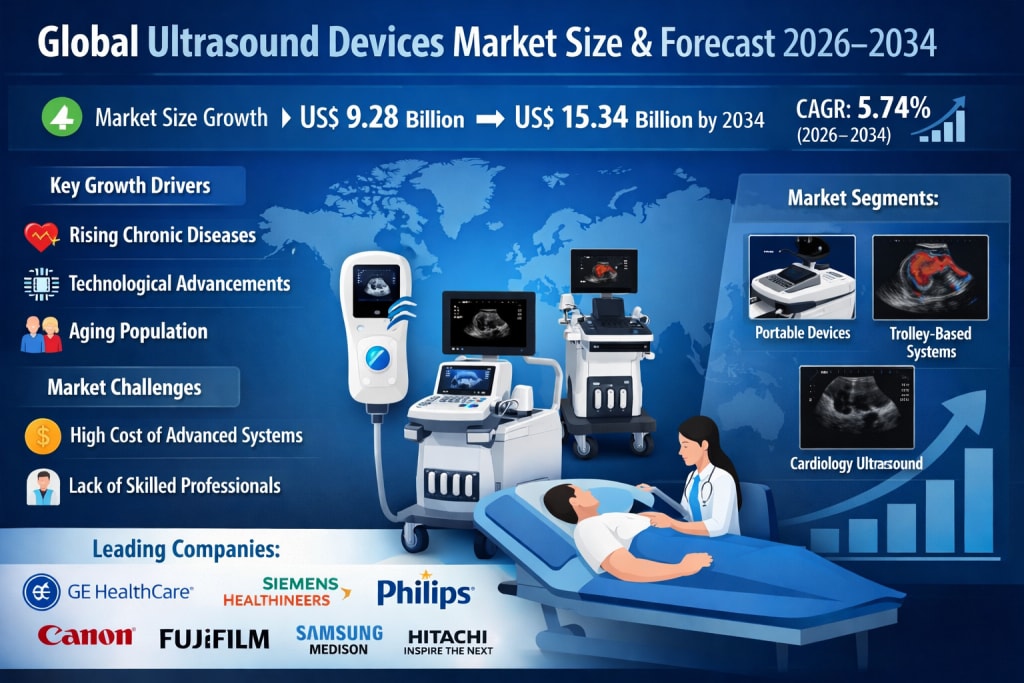
The Global Ultrasound Devices Market is witnessing strong growth as healthcare systems worldwide increasingly adopt non-invasive diagnostic technologies. Ultrasound imaging has become an essential medical tool due to its ability to provide real-time images without exposing patients to radiation. According to industry analysis, the Ultrasound Devices Market is expected to grow from US$ 9.28 Billion in 2025 to US$ 15.34 Billion by 2034, expanding at a Compound Annual Growth Rate (CAGR) of 5.74% during 2026–2034.
This growth is driven by several factors, including the rising prevalence of chronic diseases, increased use of ultrasound in obstetrics and cardiology, and the expansion of healthcare infrastructure across developing economies. Additionally, ongoing technological advancements—such as AI-enabled imaging, handheld ultrasound devices, and improved visualization techniques—are transforming how ultrasound is used in clinical practice.
As healthcare providers focus more on early diagnosis, preventive care, and efficient patient management, ultrasound technology continues to play a vital role in modern healthcare systems worldwide.
Global Ultrasound Devices Market Overview
Ultrasound devices are widely used in the healthcare sector to diagnose, monitor, and analyze a wide range of medical conditions. These devices operate by emitting high-frequency sound waves that travel through the body and reflect off internal organs, tissues, and blood vessels. The returning echoes are then converted into detailed images that allow healthcare professionals to assess internal structures in real time.
One of the biggest advantages of ultrasound imaging is that it does not involve ionizing radiation, making it safer compared to other diagnostic imaging technologies such as CT scans or X-rays. Because of this safety profile, ultrasound is commonly used in pregnancy monitoring, where it helps physicians observe fetal development and identify potential complications.
Beyond obstetrics, ultrasound devices are also widely used in cardiology, radiology, abdominal imaging, musculoskeletal analysis, and vascular studies. The versatility of ultrasound technology makes it an indispensable diagnostic tool across multiple medical specialties.
In recent years, technological advancements have significantly improved the capabilities of ultrasound systems. Modern devices now offer higher image resolution, 3D and 4D imaging capabilities, and enhanced data sharing features. Furthermore, the development of compact and handheld ultrasound devices has made this technology accessible even in smaller clinics and rural healthcare settings.
Growing awareness of preventive healthcare, rising global disease burden, and improved healthcare infrastructure are further contributing to the increasing demand for ultrasound devices worldwide.
Growth Drivers of the Ultrasound Devices Market
Increasing Demand for Non-Invasive Diagnostic Imaging
One of the primary factors driving the growth of the ultrasound devices market is the increasing demand for non-invasive diagnostic imaging techniques. Healthcare providers and patients alike prefer diagnostic methods that minimize risks, discomfort, and recovery time.
Ultrasound imaging allows physicians to visualize internal organs and tissues without the need for surgical procedures or exposure to harmful radiation. As a result, ultrasound is widely used for applications such as pregnancy monitoring, cardiac imaging, abdominal examinations, and musculoskeletal assessments.
Another key advantage of ultrasound technology is its ability to provide real-time imaging, which allows physicians to monitor organ function, detect abnormalities, and guide medical procedures with greater precision. This real-time capability makes ultrasound particularly valuable in emergency medicine and surgical procedures.
Additionally, the global healthcare industry is increasingly focusing on early disease detection and preventive healthcare strategies. Ultrasound plays a critical role in these efforts by enabling physicians to identify medical conditions at early stages, improving treatment outcomes and reducing healthcare costs.
Technological collaborations are further accelerating innovation in ultrasound imaging. For instance, in December 2025, GE HealthCare highlighted new innovations resulting from an expanded collaboration with NVIDIA, aimed at enhancing imaging performance through advanced computing technologies.
Technological Advancements and Development of Portable Devices
Technological innovation has significantly enhanced the performance and usability of ultrasound devices. Over the past decade, manufacturers have introduced advanced systems that offer improved imaging clarity, faster processing speeds, and better diagnostic capabilities.
Modern ultrasound systems now include 3D and 4D imaging technologies, which allow healthcare providers to visualize anatomical structures with greater depth and detail. These capabilities are particularly valuable in obstetrics, cardiology, and oncology.
Another important development in the ultrasound industry is the emergence of portable and handheld ultrasound devices. These compact systems allow physicians to perform diagnostic imaging at the patient’s bedside or in remote locations, making them ideal for emergency medicine and point-of-care applications.
Portable ultrasound systems are especially beneficial in rural healthcare settings where access to advanced imaging equipment may be limited. By enabling quick and accurate diagnoses, these devices help improve patient outcomes and expand access to medical care.
Manufacturers are also integrating digital connectivity features into ultrasound devices, allowing healthcare providers to store, share, and analyze imaging data more efficiently. These advancements enhance collaboration among medical teams and improve clinical decision-making.
In June 2025, Royal Philips introduced the Flash Ultrasound System 5100 POC, a point-of-care ultrasound solution designed for critical care, anesthesia, emergency medicine, and musculoskeletal imaging.
Rising Prevalence of Chronic Diseases and Aging Population
The increasing prevalence of chronic diseases is another major factor driving demand for ultrasound devices worldwide. Conditions such as cardiovascular diseases, cancer, kidney disorders, and liver diseases require advanced diagnostic imaging for accurate diagnosis and monitoring.
Ultrasound imaging plays a critical role in detecting these diseases at early stages and monitoring their progression. For example, cardiology ultrasound systems—also known as echocardiography systems—are widely used to evaluate heart function, detect structural abnormalities, and assess blood flow.
In addition to rising disease burden, the global population is aging rapidly. Older individuals are more susceptible to chronic conditions, increasing the need for routine medical examinations and diagnostic imaging services.
According to global demographic projections, by 2030, one in six people worldwide will be aged 60 years or older. The population of individuals aged 60 and above is expected to increase from 1 billion in 2020 to 1.4 billion by 2030, and reach 2.1 billion by 2050. Furthermore, the number of people aged 80 and above is projected to triple to approximately 426 million by 2050.
This growing elderly population will significantly increase demand for diagnostic imaging technologies, including ultrasound systems.
Challenges of the Ultrasound Devices Market
High Cost of Advanced Ultrasound Systems
Despite strong market growth, several challenges continue to affect the adoption of ultrasound devices. One of the most significant barriers is the high cost associated with advanced ultrasound systems.
Modern ultrasound devices equipped with features such as 3D/4D imaging, high-resolution displays, and AI-enabled analytics can be expensive for healthcare providers to purchase and maintain. In addition to equipment costs, healthcare facilities must also invest in installation, maintenance, and software upgrades.
For hospitals and clinics operating in developing economies, budget limitations can make it difficult to adopt advanced ultrasound technologies. As a result, many healthcare facilities continue to rely on older systems that may offer lower imaging accuracy.
Reducing equipment costs and improving affordability will be crucial for expanding the adoption of advanced ultrasound systems worldwide.
Shortage of Skilled Professionals and Training Requirements
Another key challenge facing the ultrasound devices market is the shortage of trained professionals capable of operating ultrasound equipment and interpreting imaging results.
Ultrasound imaging requires specialized training, as incorrect interpretation of images can lead to misdiagnosis and inappropriate treatment. In many developing countries, there is a shortage of skilled sonographers and radiologists who are trained to perform ultrasound examinations.
Additionally, the rapid pace of technological innovation means that healthcare professionals must continuously update their knowledge and skills to operate newer systems effectively.
Investments in medical education, training programs, and certification initiatives will therefore be essential to ensure the effective use of ultrasound technology in healthcare systems worldwide.
Key Market Segments
Diagnostic Ultrasound Devices Market
Diagnostic ultrasound systems represent one of the largest segments within the ultrasound devices market. These systems are widely used to evaluate internal organs, tissues, and blood circulation in order to detect medical conditions.
Hospitals and diagnostic centers rely heavily on diagnostic ultrasound systems for identifying conditions such as tumors, liver disorders, kidney diseases, and pregnancy complications. Their ability to provide real-time imaging and non-invasive diagnosis makes them a preferred choice among healthcare professionals.
As awareness of preventive healthcare continues to grow, demand for diagnostic ultrasound systems is expected to increase steadily in the coming years.
Trolley/Cart-Based Ultrasound Devices Market
Trolley or cart-based ultrasound devices are full-sized systems commonly used in hospitals and large healthcare facilities. These devices offer superior imaging capabilities, larger display screens, and advanced software features that support detailed diagnostic analysis.
Due to their high performance and reliability, cart-based systems remain the preferred choice for complex medical procedures and high-volume hospital environments.
The increasing number of hospital admissions and the need for accurate diagnostic imaging are driving demand for these systems globally.
Cardiology Ultrasound Devices Market
Cardiology ultrasound systems, also known as echocardiography systems, are designed to evaluate the structure and function of the heart. These devices allow physicians to examine heart valves, assess blood flow, and detect cardiovascular abnormalities.
With cardiovascular diseases remaining one of the leading causes of death globally, demand for advanced cardiac imaging technologies continues to grow. Echocardiography systems enable physicians to diagnose heart conditions early and develop effective treatment plans.
Growing awareness of heart health and advancements in cardiovascular imaging technologies are expected to support steady growth in this segment.
Color Ultrasound Devices Market
Color ultrasound devices utilize Doppler imaging technology to visualize blood flow and tissue movement in color. This capability allows physicians to detect abnormalities in blood circulation and vascular structures more accurately.
Color Doppler ultrasound systems are widely used in cardiology, vascular imaging, and obstetrics, where accurate visualization of blood flow is essential for diagnosis and treatment planning.
As healthcare providers seek more precise diagnostic tools, demand for color ultrasound systems is expected to increase significantly.
Regional Market Insights
United States
The United States represents one of the largest markets for ultrasound devices due to its advanced healthcare infrastructure and high adoption of medical imaging technologies. Rising prevalence of chronic diseases and growing healthcare expenditures are key factors driving market growth.
In January 2025, Samsung Medison launched the Samsung Z20, an AI-powered ultrasound system designed specifically for obstetric and gynecological applications in the U.S.
United Kingdom
The United Kingdom ultrasound market is expanding steadily due to the presence of the National Health Service (NHS) and increasing demand for diagnostic imaging. Growing chronic disease burden and an aging population are key drivers in the region.
In January 2026, a High-Intensity Focused Ultrasound system called JC200 was installed at Churchill Hospital, enabling patients at Oxford University Hospitals to benefit from advanced ultrasound treatment technologies.
India
India’s ultrasound devices market is experiencing rapid growth due to expanding healthcare infrastructure, increasing health awareness, and rising demand for diagnostic services. Government initiatives aimed at improving access to healthcare in rural areas are also supporting market growth.
Additionally, the development of affordable and portable ultrasound devices has made diagnostic imaging more accessible to smaller clinics and healthcare facilities.
Saudi Arabia
Saudi Arabia is emerging as an important market for ultrasound devices due to increasing government investments in healthcare infrastructure. Rising prevalence of chronic diseases and growing healthcare awareness are driving demand for diagnostic imaging technologies.
Healthcare providers in the country are increasingly adopting portable ultrasound devices that offer high-quality imaging while maintaining mobility and ease of use.
Competitive Landscape
Leading companies in the global ultrasound devices market are focusing on technological innovation, strategic partnerships, and product development to strengthen their market positions.
Key companies operating in the market include:
GE Healthcare
Siemens Healthcare
Philips
Canon Inc.
Fujifilm Holdings Corporation
Samsung Medison Co. Ltd.
Hitachi Ltd.
These companies continue to invest heavily in research and development to introduce advanced imaging technologies that enhance diagnostic accuracy and improve patient outcomes.
Final Thoughts
The global ultrasound devices market is poised for steady expansion over the next decade as healthcare systems increasingly rely on non-invasive diagnostic technologies. The combination of rising chronic disease prevalence, growing elderly populations, and technological innovation is creating strong demand for ultrasound imaging worldwide.
Portable ultrasound systems, AI-enabled imaging platforms, and improved visualization technologies are transforming how healthcare professionals diagnose and treat medical conditions.
As healthcare infrastructure continues to expand across emerging economies and awareness of preventive healthcare increases, ultrasound devices will remain a cornerstone of modern medical diagnostics. With continuous technological advancements and broader accessibility, the ultrasound devices market is expected to play an even more critical role in shaping the future of global healthcare.
About the Creator
Australia Olive Oil Market Growth, Forecast, and Strategic Insights by 2034
Olive oil has become a staple ingredient in modern Australian kitchens, reflecting changing dietary habits and a growing interest in healthier cooking oils. Known for its nutritional benefits and versatility, olive oil is widely used across households, restaurants, and food processing industries. As Australian consumers increasingly prioritize natural and heart-healthy food products, olive oil consumption continues to rise across the country.
By Amélie Bellea day ago in Trader



Comments
There are no comments for this story
Be the first to respond and start the conversation.