
Saudi Arabia In-Vitro Diagnostics Market Size and Forecast 2026–2034
Rising Demand for Early Disease Detection and Healthcare Investments Driving Market Growth

Introduction
Healthcare systems across the globe are evolving rapidly as countries prioritize early diagnosis, disease prevention, and improved treatment outcomes. In this transformation, in-vitro diagnostics (IVD) plays a critical role by enabling healthcare professionals to detect diseases quickly and accurately using laboratory tests performed on biological samples.
Saudi Arabia is witnessing a strong surge in demand for diagnostic technologies due to the growing burden of chronic diseases, increased healthcare spending, and ongoing modernization of the country’s medical infrastructure. These factors are encouraging the widespread adoption of advanced diagnostic tools across hospitals, laboratories, and clinics.
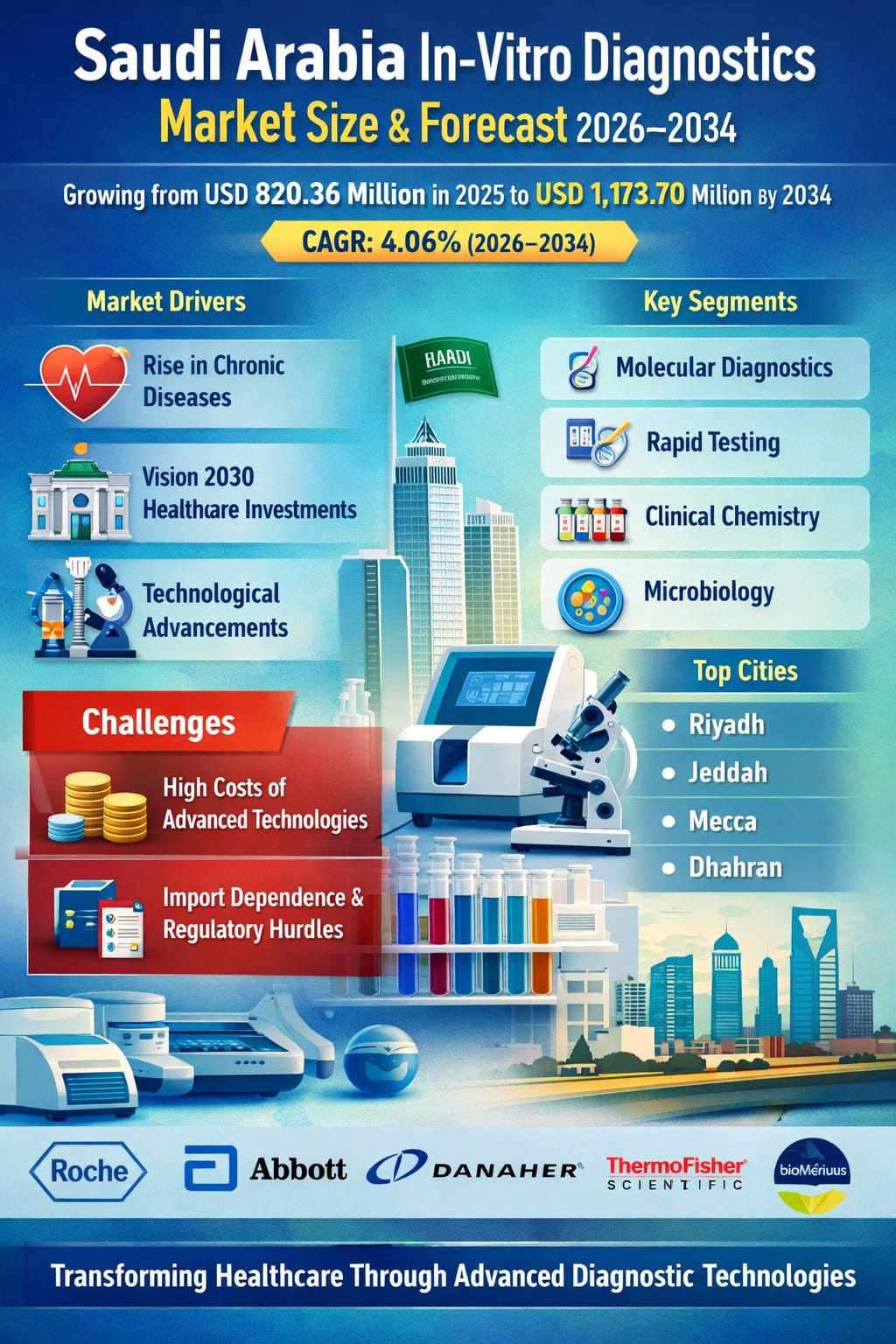
According to Renub Research, the Saudi Arabia In-Vitro Diagnostics Market is projected to expand from US$ 820.36 million in 2025 to US$ 1,173.70 million by 2034, growing at a CAGR of 4.06% from 2026 to 2034. This growth highlights the importance of diagnostic testing in improving healthcare outcomes and strengthening Saudi Arabia’s healthcare ecosystem.
Saudi Arabia IVD Market Overview
In-vitro diagnostics refers to medical tests conducted outside the human body using biological samples such as blood, urine, tissue, or other bodily fluids. These tests are performed in laboratories or diagnostic centers and are essential for detecting diseases, monitoring treatment responses, and evaluating overall health conditions.
IVD technologies include a wide range of products such as:
Diagnostic reagents
Testing kits
Analytical instruments
Laboratory software systems
These products support multiple medical disciplines including clinical chemistry, immunology, hematology, molecular diagnostics, and microbiology.
The role of IVD is particularly crucial in early disease detection, enabling doctors to identify health conditions at an early stage and initiate timely treatment. As a result, diagnostic testing has become a central pillar of modern healthcare systems.
In Saudi Arabia, the demand for IVD solutions has increased significantly due to the rising prevalence of diabetes, cardiovascular diseases, cancer, and infectious diseases. At the same time, government initiatives aimed at improving healthcare infrastructure under the Vision 2030 program are strengthening diagnostic capabilities across the country.
Growing awareness among patients about preventive healthcare and early diagnosis is also driving demand for laboratory testing services. Additionally, the expansion of private diagnostic laboratories and hospitals has further accelerated the adoption of advanced IVD technologies.
Growth Drivers of the Saudi Arabia In-Vitro Diagnostics Market
Rising Prevalence of Chronic and Lifestyle-Related Diseases
One of the major factors fueling the growth of the Saudi Arabia IVD market is the increasing prevalence of chronic diseases and lifestyle-related disorders.
Saudi Arabia has one of the highest rates of metabolic and lifestyle diseases in the Middle East. According to health estimates:
Around 25% of the population suffers from hypertension
Approximately 23% of people are affected by diabetes
Obesity levels remain high across different age groups
These conditions significantly increase the risk of cardiovascular diseases, kidney disorders, and other complications.
Managing such diseases requires continuous diagnostic monitoring through regular blood tests, metabolic screening, and biomarker analysis. As healthcare providers emphasize preventive medicine and early detection, diagnostic testing volumes are rising steadily across hospitals and laboratories.
Furthermore, growing awareness among patients regarding routine health screening and disease prevention is encouraging more people to undergo diagnostic testing. This shift toward proactive healthcare management is expected to continue boosting the demand for IVD technologies in Saudi Arabia.
Government Healthcare Investments and Vision 2030 Initiatives
Saudi Arabia’s Vision 2030 healthcare transformation program is another major factor driving the growth of the IVD market.
Under this national development plan, the government is making significant investments to improve healthcare infrastructure, expand hospital networks, and enhance diagnostic capabilities across the country. The initiative aims to create a modern, technology-driven healthcare ecosystem that delivers high-quality medical services to citizens.
Several key initiatives supporting the IVD sector include:
Expansion of hospital and laboratory infrastructure
Encouragement of private healthcare investments
Integration of digital health technologies
Public-private partnerships in healthcare delivery
These initiatives are helping to modernize diagnostic facilities and introduce advanced laboratory technologies across Saudi Arabia.
A notable example occurred in October 2025, when the Global Health Exhibition in Riyadh announced strategic partnerships and healthcare investments exceeding US$33 billion during its opening day. This development reinforced Saudi Arabia’s position as an emerging global hub for healthcare innovation and investment.
Such large-scale investments are expected to significantly boost the adoption of advanced diagnostic technologies and expand the IVD market in the coming years.
Technological Advancements and Adoption of Molecular Diagnostics
Technological innovation has played a crucial role in transforming the global diagnostics industry, and Saudi Arabia is rapidly adopting these advancements.
Modern IVD technologies such as molecular diagnostics, automated laboratory systems, and point-of-care testing devices are improving the accuracy, speed, and efficiency of diagnostic procedures.
Among these technologies, molecular diagnostics has gained particular importance due to its ability to detect infectious pathogens, genetic abnormalities, and cancer biomarkers with high precision.
These tests are widely used for:
Infectious disease detection
Cancer diagnostics
Genetic screening
Personalized medicine applications
Automation and digitalization of laboratory workflows are also helping diagnostic centers process large volumes of tests while reducing turnaround time and human errors.
In September 2025, Co-Diagnostics Inc. announced a strategic Memorandum of Understanding (MOU) with a Saudi-based manufacturing and distribution company to explore a joint venture for developing and distributing Co-Dx PCR point-of-care diagnostic products across the Middle East and North Africa.
Such collaborations highlight the increasing focus on advanced diagnostic technologies in Saudi Arabia and their growing role in improving healthcare delivery.
Challenges in the Saudi Arabia In-Vitro Diagnostics Market
High Cost of Advanced Diagnostic Technologies
Despite strong market growth, the high cost associated with advanced diagnostic technologies remains a major challenge.
Sophisticated diagnostic solutions such as molecular testing platforms, automated laboratory analyzers, and genetic testing equipment require substantial investment. In addition to equipment costs, laboratories must also bear expenses related to maintenance, reagents, and technical training.
These costs can be particularly challenging for smaller hospitals and diagnostic laboratories, especially those located in non-urban regions.
Furthermore, reimbursement systems for advanced diagnostic procedures are still evolving in Saudi Arabia. Limited reimbursement coverage may restrict patient access to certain high-cost diagnostic tests, potentially slowing the adoption of advanced technologies.
Dependence on Imports and Regulatory Approval Processes
Another significant challenge for the Saudi Arabia IVD market is its strong reliance on imported diagnostic equipment and reagents.
Many advanced diagnostic systems used in Saudi laboratories are manufactured by international companies. This dependence exposes the market to potential risks such as:
Supply chain disruptions
Currency fluctuations
Delays in international shipping
In addition, regulatory approval processes for diagnostic products can sometimes be complex and time-consuming. While strict regulatory oversight ensures product safety and quality, it may delay the introduction of innovative diagnostic solutions in the market.
Key Market Segments in Saudi Arabia’s IVD Industry
ELISA and CLIA Diagnostic Testing
The ELISA (Enzyme-Linked Immunosorbent Assay) and CLIA (Chemiluminescent Immunoassay) testing segment is experiencing steady growth in Saudi Arabia.
These technologies are widely used to detect infectious diseases, autoimmune disorders, hormonal imbalances, and cancer markers.
CLIA systems are gaining popularity due to their high sensitivity, automation capabilities, and faster processing times. Hospitals and large diagnostic laboratories increasingly rely on automated ELISA and CLIA analyzers to improve testing efficiency and diagnostic accuracy.
Rapid Diagnostic Testing
The demand for rapid diagnostic tests has grown significantly in recent years, especially following the COVID-19 pandemic.
Rapid tests offer several advantages:
Fast results within minutes
Minimal infrastructure requirements
Easy usage in clinics and emergency settings
These tests are commonly used for pregnancy detection, infectious disease screening, cardiac marker testing, and blood glucose monitoring.
With the increasing focus on point-of-care testing, rapid diagnostics are expected to remain an important component of the Saudi Arabia IVD market.
Reagents Market
Reagents represent one of the most significant revenue-generating segments in the IVD industry.
Diagnostic reagents are essential components used in almost all laboratory tests. As testing volumes increase due to chronic disease monitoring and preventive health programs, the demand for high-quality reagents continues to grow.
Although most reagents are imported, the increasing adoption of automated laboratory systems is expected to drive consistent demand in this segment.
Clinical Chemistry Diagnostics
Clinical chemistry testing remains one of the largest segments in Saudi Arabia’s IVD market.
These tests are widely used to assess metabolic functions, including:
Blood glucose levels
Lipid profiles
Kidney function
Liver enzyme levels
Electrolyte balance
The rising prevalence of diabetes and cardiovascular diseases in Saudi Arabia ensures consistent demand for these routine diagnostic tests.
Microbiology Diagnostics
The microbiology segment focuses on detecting bacterial, viral, and fungal infections.
Growing concerns about hospital-acquired infections and antimicrobial resistance have increased the importance of microbiological testing in healthcare settings.
Modern diagnostic systems such as automated culture platforms and rapid pathogen detection technologies are improving the efficiency of microbiology laboratories across Saudi Arabia.
Regional Insights: Key Cities Driving Market Growth
Riyadh
Riyadh represents the most developed IVD market in Saudi Arabia due to its advanced healthcare infrastructure. The city hosts numerous hospitals, research institutions, and diagnostic laboratories that use cutting-edge diagnostic technologies.
Government investments in healthcare modernization under Vision 2030 are also heavily concentrated in Riyadh.
Jeddah
Jeddah is another major healthcare hub driven by its strong private healthcare sector and growing medical tourism industry.
The city’s well-established diagnostic laboratories and hospital networks contribute significantly to the demand for IVD testing services.
Mecca
Mecca has a unique healthcare environment due to the massive influx of pilgrims during Hajj and Umrah seasons.
Temporary healthcare facilities established during these periods rely heavily on rapid diagnostic tests and microbiology testing to manage infectious diseases and emergency health conditions.
Dhahran
Dhahran’s IVD market is supported by high-quality healthcare facilities serving corporate professionals and expatriates. The region emphasizes preventive healthcare, occupational health testing, and chronic disease monitoring.
Although the testing volume is smaller compared to larger cities, the focus on advanced diagnostic quality ensures steady market growth.
Competitive Landscape
Several global diagnostic companies operate in the Saudi Arabia IVD market, offering advanced technologies and diagnostic solutions.
Key companies include:
Roche Diagnostics
Danaher Corporation
Abbott Laboratories
Thermo Fisher Scientific
Bio-Rad Laboratories Inc.
Sysmex Corporation
Becton Dickinson
bioMérieux
These companies focus on innovation, partnerships, and product development to strengthen their presence in the rapidly expanding Saudi healthcare market.
Final Thoughts
Saudi Arabia’s healthcare sector is undergoing a remarkable transformation driven by technological innovation, increased healthcare spending, and a strong focus on preventive medicine.
As chronic diseases continue to rise and diagnostic technologies evolve, the demand for accurate and efficient diagnostic testing will remain critical.
With government initiatives under Vision 2030, expanding healthcare infrastructure, and the adoption of advanced laboratory technologies, the Saudi Arabia In-Vitro Diagnostics Market is poised for steady growth in the coming decade.
From molecular diagnostics to rapid testing solutions, IVD technologies will continue to play a vital role in shaping the future of healthcare in the Kingdom—ultimately improving disease detection, treatment outcomes, and the overall quality of life for millions of people.
About the Creator
Sakshi Sharma
Content Writer with 7+ years of experience crafting SEO-driven blogs, web copy & research reports. Skilled in creating engaging, audience-focused content across diverse industries.
Keep reading
More stories from Sakshi Sharma and writers in Trader and other communities.
Clinical Trials Market Size and Forecast 2026–2034
The global clinical trials market is entering a period of strong and sustained expansion as pharmaceutical innovation accelerates worldwide. Increasing research and development (R&D) investments, the rising burden of chronic diseases, and rapid technological advancements in healthcare research are creating significant opportunities for the industry. Clinical trials remain the cornerstone of medical progress, ensuring that new drugs, vaccines, and medical technologies are safe and effective before reaching patients.
By Sakshi Sharma3 days ago in Trader
Why Didn't Anyone Tell Us
Men, move along. This is not for you. This is for the women. I was forty-five when I began menopause. It is pretty young for that to be going on in a woman’s life, but I had undiagnosed PCOS, my entire life. Thank you to all the gynecologists I had seen my entire life. That in itself should encourage women to keep seeking second opinions, especially when you are not getting correct answers or any at all.
By Alexandra Grant3 days ago in Humans


Comments
There are no comments for this story
Be the first to respond and start the conversation.