
Qadir Bakhsh “Qadu Makrani”: Rebel Outlaw to the British, Heroic Defender to the People
The dramatic story of a Baloch warrior who challenged colonial authority and became a legend of resistance in South Asia.

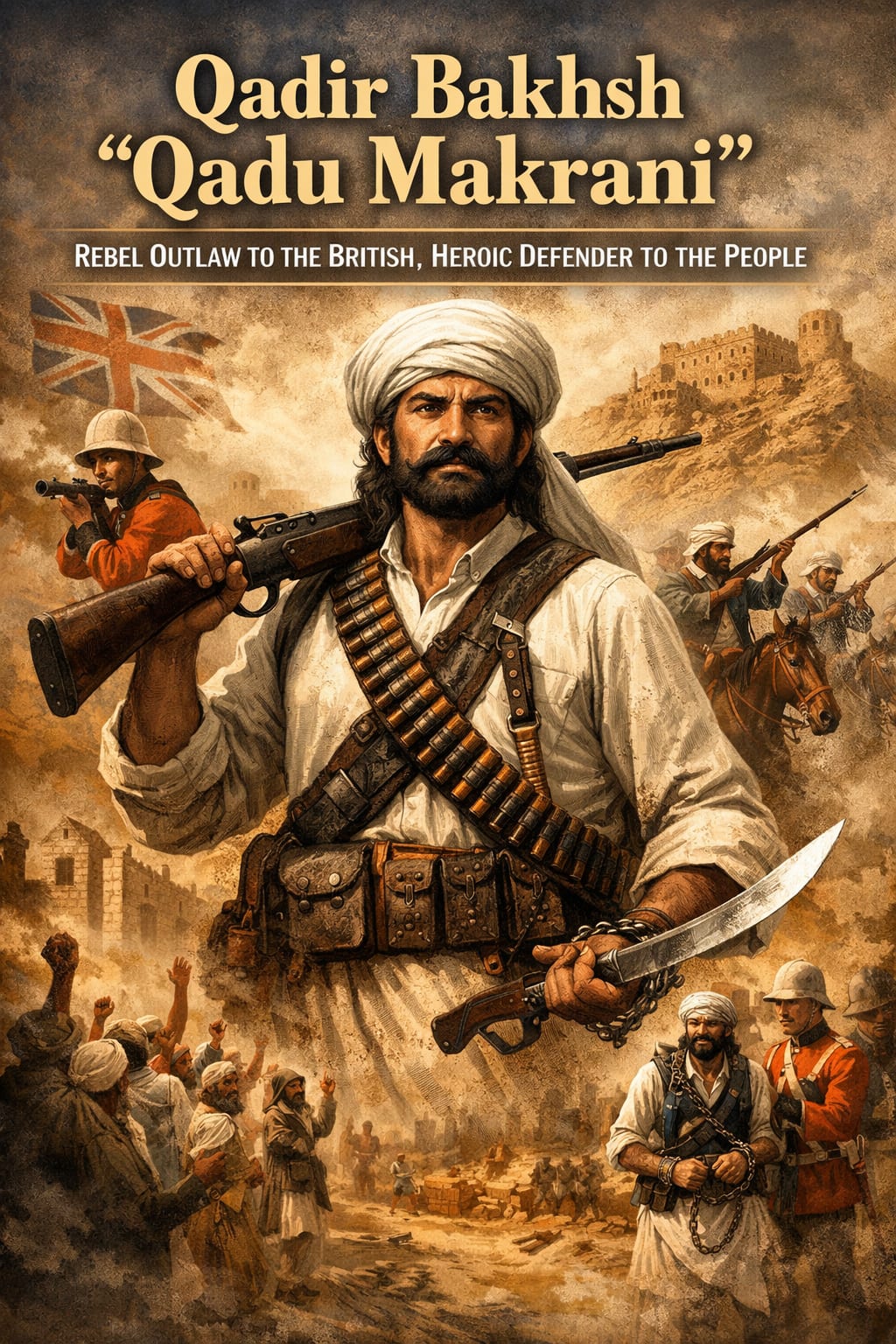
Qadir Bakhsh Rind, widely remembered as Qadu Makrani, is one of the most fascinating and controversial figures in the history of resistance against colonial rule in South Asia. To the British colonial administration, he was a dangerous outlaw and a rebellious bandit. But to many local people in present-day Balochistan and Sindh, he became a symbol of courage, resistance, and protection of the oppressed.
Qadu Makrani was born around the mid-19th century in the Makran region, an area known for its harsh landscapes and proud tribal traditions. He belonged to the Makrani Baloch community, which had a long history of independence and resistance against outside authority. From an early age, Qadu developed a reputation for bravery and physical strength. Like many men of his tribe, he grew up in a culture where honor, loyalty, and defense of one’s people were considered sacred duties.
During the late nineteenth century, the political landscape of the region was rapidly changing. The British Empire had expanded its influence over large parts of the Indian subcontinent. Through alliances with local rulers and the use of military power, British officials attempted to impose law and order in territories that had long operated according to tribal customs.
In the princely state of Junagadh, located in present-day Gujarat, tensions between colonial authorities and local tribes were increasing. Many tribal communities felt that new laws, taxes, and restrictions threatened their traditional way of life. It was in this environment that Qadu Makrani emerged as a rebel leader.
The turning point in his life reportedly came when he and members of his family were accused of crimes and faced harsh treatment from local authorities who were aligned with the British administration. Feeling that justice had been denied to him and his people, Qadu chose the path of rebellion.
Over the following years, he organized a small band of loyal followers. Moving through remote hills and forests, they launched attacks on government posts, wealthy landlords, and officials who were seen as collaborators with colonial rule. His tactics were swift and unpredictable, allowing him to evade capture for a long time.
To British officials, Qadu Makrani became a notorious criminal. Government records described him as a “dangerous outlaw” who disrupted order and threatened the authority of the state. British forces, along with the army of Junagadh, conducted extensive operations to track him down.
However, the story looked very different from the perspective of ordinary villagers. Many local people admired Qadu Makrani’s defiance. Stories spread that he protected the poor and challenged injustice. In folk songs and oral traditions, he was portrayed as a warrior who refused to bow before foreign power.
These legends turned him into something of a folk hero. People spoke about his courage, cleverness, and loyalty to his companions. Some narratives claim that he shared wealth taken from powerful landlords with poor villagers, although historians continue to debate the accuracy of such accounts.
The pursuit of Qadu Makrani eventually intensified. British and local authorities increased rewards for information about his whereabouts. After years of evading capture, he was finally betrayed and arrested in the late 1880s.
Following his capture, he was tried by colonial authorities and sentenced to death. In 1887, Qadu Makrani was executed, bringing an end to his dramatic life of rebellion. The British administration believed that his execution would discourage further resistance.
Instead, his story survived and continued to grow in local folklore. For many people in Baloch and Sindhi communities, Qadu Makrani remained a symbol of resistance against oppression. His life represented the struggle of ordinary people trying to defend their dignity and autonomy during a time of imperial expansion.
Today, historians view Qadu Makrani through multiple perspectives. Some describe him as a bandit shaped by difficult social conditions, while others see him as an early freedom fighter who challenged colonial authority long before organized nationalist movements emerged.
What is certain is that his legacy continues to inspire debate and fascination. The story of Qadu Makrani reflects the complex realities of colonial history, where the same individual could be labeled a criminal by rulers and celebrated as a hero by the people.
More than a century after his death, the legend of Qadu Makrani still echoes in regional folklore, reminding us how history often depends on who is telling the story.
About the Creator
Irshad Abbasi
Ali ibn Abi Talib (RA) said 📚
“Knowledge is better than wealth, because knowledge protects you, while you have to protect wealth.
Keep reading
More stories from Irshad Abbasi and writers in History and other communities.
Ajab Khan Afridi: The Tribal Warrior Who Kidnapped a British Officer’s Daughter
The story of Ajab Khan Afridi and the kidnapping of a British woman is one of the most dramatic and controversial episodes from the history of the tribal areas during the British colonial period in South Asia. Taking place in the early 20th century along the rugged frontier between British India and Afghanistan, the incident captured the attention of both the British authorities and the local tribes, becoming a tale of resistance, revenge, and tribal honor.
By Irshad Abbasi about 7 hours ago in History
Year 1816 in Review: Fun Facts, Trivia, and Historic Highlights
This quick read is a collection of fun facts, trivia, and historical events from the year 1816. Discover the year’s top news stories, most influential people, historic firsts, erratic weather patterns, and much more.
By Gregory DeVictor4 days ago in History




Comments
There are no comments for this story
Be the first to respond and start the conversation.