
When the Portuguese Turned the Tide of Indian History
How a small European maritime power reshaped trade, politics, and culture across the Indian Ocean in the 16th century.

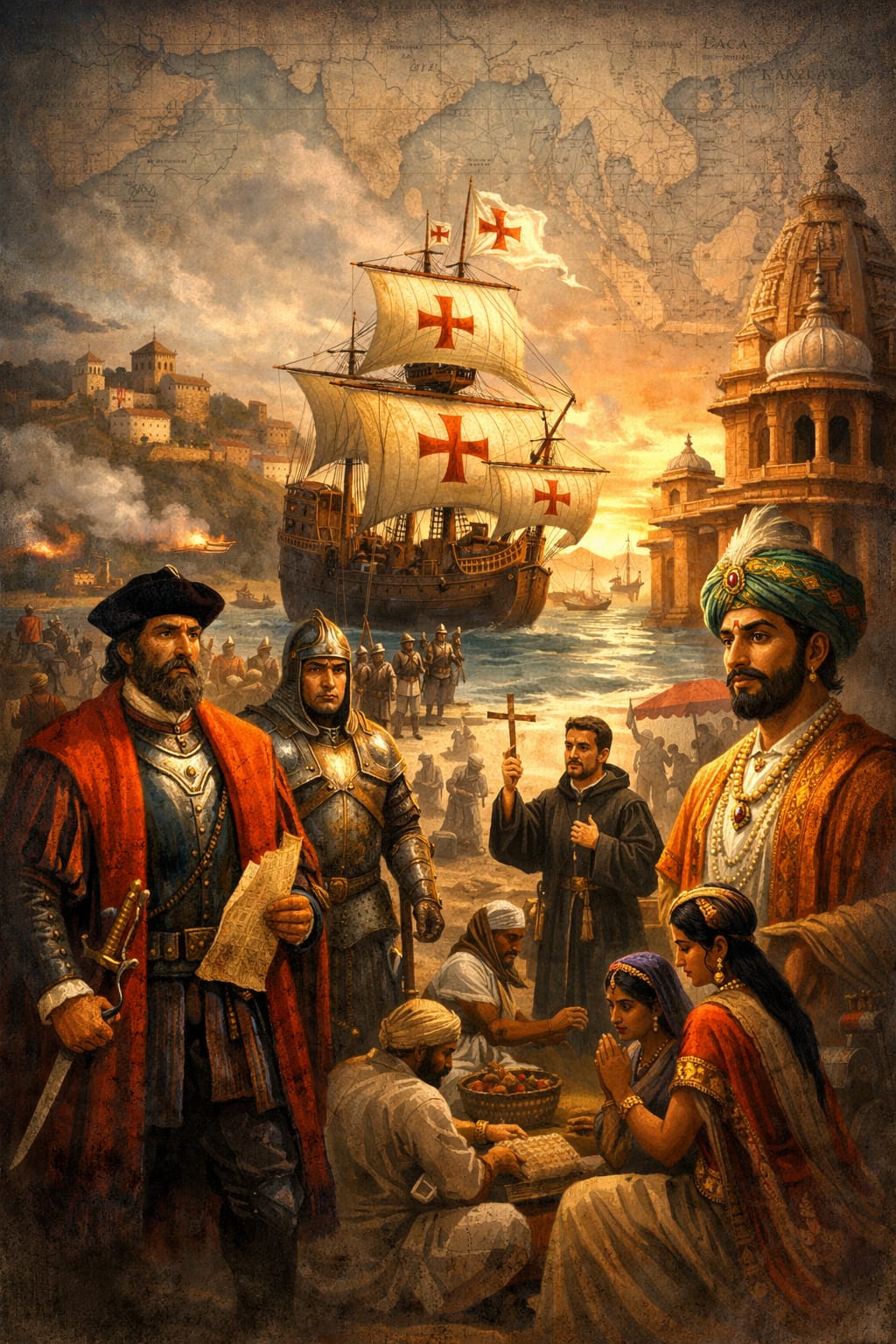
The arrival of the Portuguese in India at the end of the 15th century marked a turning point in the history of the Indian Ocean and the Indian subcontinent. What began as an ambitious maritime expedition soon transformed into a powerful political and economic presence that reshaped trade routes, introduced new cultural influences, and altered the balance of power in the region.
The story begins in 1498 when the Portuguese explorer Vasco da Gama successfully reached the Indian port city of Kozhikode (Calicut) after sailing around the Cape of Good Hope. His voyage, supported by the Portuguese king Manuel I of Portugal, opened a direct sea route from Europe to India. Before this discovery, the spice trade between Asia and Europe was dominated by Arab merchants and Venetian traders who transported goods through land and Middle Eastern routes. Vasco da Gama’s journey dramatically changed this centuries-old system.
The Portuguese were primarily interested in spices such as pepper, cinnamon, cloves, and nutmeg, which were highly valuable in European markets. By establishing direct maritime trade with India, Portugal hoped to bypass middlemen and gain control of the lucrative spice trade. However, the Portuguese soon realized that trade alone would not secure their dominance. To protect their commercial interests, they began building forts, establishing naval bases, and forming political alliances along the Indian coast.
One of the most important figures in consolidating Portuguese power in India was Afonso de Albuquerque, the second governor of Portuguese India. In 1510, he captured the coastal city of Goa from the Bijapur Sultanate. Goa soon became the capital of Portuguese India and the center of their political, military, and religious activities in the region. From this strategic base, the Portuguese expanded their influence across the Indian Ocean.
The Portuguese adopted a strategy of controlling key ports and sea routes rather than conquering vast inland territories. They established strongholds in places such as Daman, Diu, and Kochi. Through these ports, they monitored shipping traffic and imposed a system known as the “cartaz,” a naval pass that ships had to carry to sail safely in waters controlled by the Portuguese navy. This system effectively gave them a monopoly over trade in the Indian Ocean for several decades.
The Portuguese presence also brought significant cultural and religious changes. Missionaries accompanied traders and soldiers, aiming to spread Christianity in the region. One of the most famous missionaries was Francis Xavier, a Jesuit priest who traveled across India and Southeast Asia in the 16th century. Churches, schools, and religious institutions were established in Portuguese-controlled territories, particularly in Goa, which became an important center of Christian activity in Asia.
In addition to religion, the Portuguese introduced new foods, crops, and cultural practices to India. Ingredients such as chili peppers, tomatoes, and potatoes, which originally came from the Americas, were brought to the subcontinent through Portuguese trade networks. Over time, these foods became essential parts of Indian cuisine.
Despite their early success, Portuguese dominance in the Indian Ocean eventually faced challenges. By the 17th century, other European powers such as the Dutch East India Company and the British East India Company began competing for control of Asian trade. These rivals had stronger financial backing and larger fleets, which gradually weakened Portuguese influence.
Nevertheless, the Portuguese left a lasting legacy in India. Their architecture, language, and cultural traditions can still be seen in regions like Goa. Portuguese-style churches, colonial buildings, and a unique blend of Indian and European culture continue to attract visitors from around the world.
More importantly, the Portuguese arrival marked the beginning of a new era of European involvement in Asia. Their success demonstrated the strategic value of maritime exploration and global trade networks. This set the stage for centuries of European colonial expansion that would eventually reshape the political landscape of the entire region.
In many ways, the Portuguese were pioneers of a new global age. Their arrival in India did not merely open a trade route; it transformed economic systems, introduced new cultural exchanges, and shifted the dynamics of power across continents. The ripple effects of their actions continued to influence the history of India and the wider world for generations.
About the Creator
Irshad Abbasi
Ali ibn Abi Talib (RA) said 📚
“Knowledge is better than wealth, because knowledge protects you, while you have to protect wealth.
Keep reading
More stories from Irshad Abbasi and writers in History and other communities.
Hasan-i Sabbah’s Garden of Paradise: Legend or Historical Reality?
Among the many legends of medieval history, few stories are as fascinating and controversial as the tale of the “Garden of Paradise” associated with Hasan-i Sabbah. He was the founder and spiritual leader of the Nizari Ismaili movement in Persia during the 11th and early 12th centuries. From his mountain stronghold at Alamut Castle, Hasan-i Sabbah built a powerful and mysterious network of followers who became known in Western literature as the “Assassins.” One of the most enduring legends about him is the claim that he created a secret garden designed to resemble paradise, where young recruits were tricked into believing they had experienced heaven.
By Irshad Abbasi about an hour ago in History
The World on the Brink
The World on the Brink: War Expands Across the Middle East The world is watching with growing concern as a major conflict spreads across the Middle East. What began as military strikes between Israel and Iran has quickly expanded into a broader regional crisis involving multiple countries and armed groups. Military actions, missile attacks, and political tensions are now affecting not only the Middle East but also global markets and international security.
By Wings of Time 3 days ago in History


Comments
There are no comments for this story
Be the first to respond and start the conversation.