politicians
Reviews of the politicians kissing babies and running governments around the world; applaud and criticize the decisions they make and their implications.
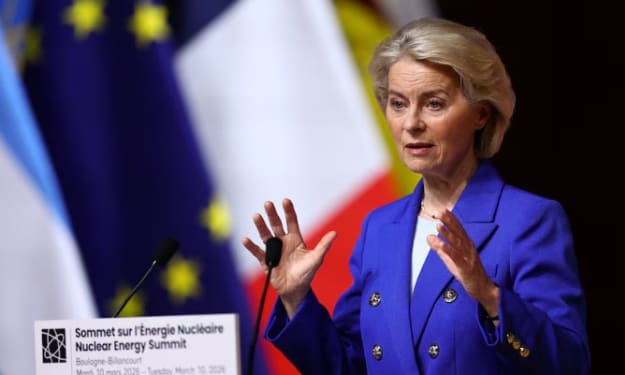
Reducing Europe’s Nuclear Energy Sector Was a “Strategic Mistake,” EU Chief Says. AI-Generated.
Europe’s energy policy has long been shaped by debates over sustainability, safety, and energy independence. In recent years, those debates have intensified as global energy demands rise and geopolitical tensions disrupt traditional energy supplies. Now, a major voice within the European leadership has publicly acknowledged what many analysts have argued for years: reducing the continent’s nuclear energy sector may have been a strategic mistake.
By Jameel Jamali2 days ago in The Swamp
Shots Fired at U.S. Consulate in Toronto, Police Say. AI-Generated.
Early Tuesday morning, authorities in Canada launched an investigation after gunfire was reported at the United States Consulate in downtown Toronto. The incident, which occurred before sunrise, has drawn international attention and prompted heightened security around diplomatic buildings across the country. Fortunately, no injuries were reported, but officials say the event is being treated as a serious national security matter.
By Jameel Jamali2 days ago in The Swamp
Let's Play A Game
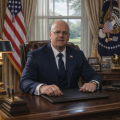
Playing Politics The other day, while bored, I started playing around with ChatGPT. It’s fun, and there are things that people can use it to have a little fun with, and to help with projects. I wanted to see what I’d look like sitting at the resolute desk in the Oval Office.
By Jason Ray Morton 3 days ago in The Swamp
Iranian Soccer Team Exits Women’s Asian Cup and Faces Tricky Prospect of Return Home. AI-Generated.
The Iranian women’s national football team’s campaign at the 2026 AFC Women’s Asian Cup came to a somber end on Sunday with a 2–0 defeat to the Philippines on the Gold Coast in Queensland, Australia, condemning them to an early exit from the tournament. The loss, following earlier defeats to South Korea and Australia, leaves the squad reflecting not only on their performance on the pitch but also on the profound uncertainty that awaits them as they prepare for the journey back to their homeland — where political tensions, war and allegations of persecution now loom large. The team had arrived in Australia last month ahead of the tournament, mere days before a significant escalation of conflict in the region triggered by U.S. and Israeli air strikes on Iran on February 28. That conflict has only heightened anxieties about what players — especially those visible on the international stage — might face on their return. Silence, Anthem Controversy, and the Backlash Iran’s campaign became politically charged from the outset. Before their opening match against South Korea, the team stood in silence during the national anthem, a gesture interpreted by many international commentators and human rights activists as a possible act of protest, mourning, or dissent given the wartime backdrop. That moment reverberated back home: Iranian state media branded the players “wartime traitors”, a designation with serious implications in a legal system where charges of treason can carry grave penalties. In subsequent matches — including the final group game against the Philippines — the players did sing and salute the anthem. But the damage in the eyes of state media and hardline commentators had already been done, and the controversy continued to cast a long shadow. Protesters, Petitions, and Concerns on the Gold Coast As the Iranian squad prepared to depart Australia following their exit from the tournament, dramatic scenes unfolded outside Gold Coast Stadium. Supporters and activists surrounded the team bus, chanting slogans such as “let them go” and “save our girls,” and briefly impeding its movement. Police intervened to disperse crowds of up to around 200 people in what was described as chaotic scenes. Locally based Iranian community organisations and human rights advocates have called on Australian authorities to ensure the team’s safety and to provide the players with the opportunity to seek protection if they fear persecution when returning home. One widely circulated online petition, supported by tens of thousands of people, urges Australian officials to guarantee independent legal counsel, interpreter support, and safe, private interviews for any player who expresses fear about going back to Iran. Government Response and Asylum Debate The emotional and political complexities of the situation have prompted responses at the highest levels of Australia’s government. Foreign Minister Penny Wong expressed public solidarity with the Iranian players and acknowledged the broader oppression faced by women in Iran, but stopped short of detailing any specific protection plans or whether government officials had communicated directly with the players. Advocates for the team argue that Iran’s current wartime environment — and the punitive rhetoric broadcast by state-controlled media — create credible risks of persecution, imprisonment, or worse for players labelled “disloyal” upon their return. Several former athletes and civil society groups have called on football’s governing bodies, including FIFA and the Asian Football Confederation (AFC), to intervene and uphold their obligations to protect athletes’ safety during and after competition. Some Australian lawmakers — including opposition figures — have gone further by urging the government to offer temporary protection or even asylum to team members, arguing that humanitarian commitments should take precedence in such an extraordinary case. Yet officials have reiterated that any such actions would need to adhere to standard immigration and visa processes unless players themselves formally request protection. The Road Ahead: Homecoming in Limbo For the players themselves, emotions are mixed. Iran’s coach Marziyeh Jafari has publicly stated that the squad wants to return home and be reunited with family and compatriots, emphasizing their eagerness to go back despite the tumultuous backdrop. Others within the team have voiced concern for their loved ones still in Iran, where widespread social unrest and wartime tensions persist. As arrangements for their departure from Australia are finalised, many questions remain unanswered: Will they return to a warm welcome, or face suspicion and reprisals? Does international sport carry a responsibility to protect athletes beyond the pitch? And what does this saga mean for the future of women’s sport in Iran amid a deeply polarized political climate? The answers — and the fate of these players — are still very much to be determined.
By Fiaz Ahmed 4 days ago in The Swamp
Former President Obama will welcome former President Bush, not Trump to Obama Presidential Center ceremonies, per report
The shade is real. In what looks like a master troll operation, former president Barack Obama has shunned President Trump from taking part in the unveiling of the Obama Presidential Center in Washington, DC.
By Skyler Saunders5 days ago in The Swamp
Judge Rules Kari Lake Unlawfully Ran U.S. Media Agency, Voiding Layoffs. AI-Generated.
A federal judge has ruled that former Arizona political candidate Kari Lake unlawfully exercised authority over a U.S. government-funded media agency, a decision that has nullified a series of layoffs and triggered renewed debate about leadership and governance in publicly funded international broadcasting.
By Jameel Jamali5 days ago in The Swamp
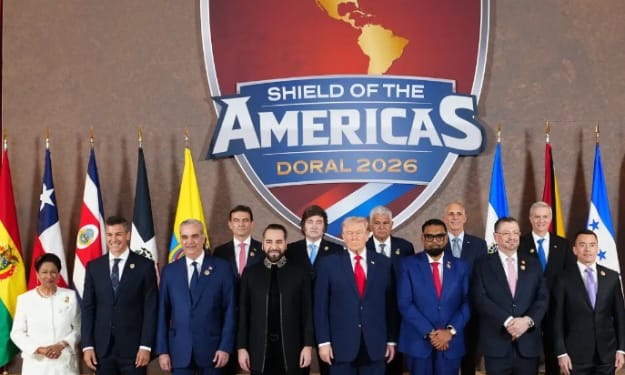
Trump Assembles a New Coalition to ‘Eradicate’ Cartels. AI-Generated.
In the evolving landscape of American politics and national security, former U.S. President Donald Trump has once again ignited debate with a bold proposal: forming a new coalition aimed at “eradicating” powerful drug cartels operating across the Americas. The initiative, framed as a comprehensive strategy to combat organized crime and drug trafficking, has stirred support among allies and raised significant questions among critics about its feasibility, legality, and long-term implications.
By Jameel Jamali5 days ago in The Swamp
Doing the Wash
Congress. An entity of our government that is supposed to be working for us, is just a money laundering criminal endeavor. If you aren't paying attention to what our government does, then you are part of the problem.Money laundering is a crime, and we are funding it.
By Alexandra Grant5 days ago in The Swamp
The First Casualty Of War Is The Truth
It is often said that in times of war, the first casualty is the truth. When Donald Trump launched Operation Epic Fury, he said that the goal was to stop Iran from developing nuclear weapons. At the same time, when the head of the International Atomic Energy Agency (IAEA), Rafael Grossi, was asked about it, he said that they do not even have access to the sites. Therefore, they have no clear idea about what is happening there, and he appeared somewhat confused.
By Ibrahim Shah 6 days ago in The Swamp
U.S. strategic competition with China.
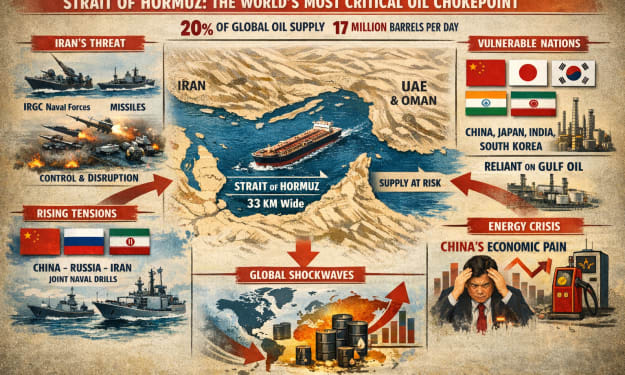
This war Stop being a medley story the moment the first oil tanker changed course in the Persian Gulf. What I mean is, Strait of Hormuz is the most important energy bottleneck on earth. Everybody knows it is the most important energy bottleneck on earth. And if it was the threat from Iran last time, this time Iran has partially done it. It is so narrow, IRGC has a lot of control over it. Just like in the Strait of Malacca, army/navy has control over it. Similarly, here the Iranians have control over it. And recently, China, Russia, and Iran have already conducted war games. So it is this narrow, 33 kilometers wide, you are hearing about it everywhere, everybody is talking about it. It is the width of a large city. So in this narrow passage, which holds 20% of the world's oil, one fifth of the world's oil and gas goes through, it is around 17 million barrels per day. There is no realistic alternative route except the Strait of Hormuz. If we close this passage, its consequences will not stop at any one border. Europe will pay, Japan will pay, India, South Korea, China, everybody pays the price. So a theory is floating around, which backs my argument that China is the target. It is that in Washington circles, there is a discussion going on, let's be honest, if this happens, what do we have to do? The hawkish people there say that this disruption should be allowed because it does not impact them as much as it impacts those countries, which I have just mentioned. So let's take this opportunity that the slowdown of China's energy supply can be slowed down. Trap Beijing in such an expensive moment as long as this congestion remains in the Strait of Hormuz, it remains closed, partially or completely. Iran keeps Beijing hit very badly from an energy security point of view. So the containment policy of China that is already going on is an added bonus. So imagine, on one hand, you are doing everything with technology and trade, imposing tariffs, treating them in the South China Sea, imagine all this. And from the other side, almost 90% of the oil and gas supplies go to China. If it is blocked for a few days, how badly it will hit China. So imagine, while the world is suffering, they are only having strategic designs in their minds.
By Ibrahim Shah 6 days ago in The Swamp